
This is Part 2 of our watchdog series on Oneida County shoreline zoning. Catch up on Part 1- which details the initial 2023 courthouse showdown and early DNR warnings—[read Part 1 here].
The Origin: Public Pushback on Two Sisters Lake
In 2020, an aggressive clear-cutting project on Two Sisters Lake sparked public calls for tighter rules.
In August 2021, County Conservation Committee Chair Bob Mott stepped forward to address the outcry. He formally submitted four policy proposals to the P&D Committee aimed at curbing soil erosion and protecting shoreline trees.
Instead of strengthening protections, the P&D Committee did the exact opposite. When officials unveiled Ordinance Amendment #13-2022 in late 2022, residents discovered the new draft actually loosened limits on boathouses, expanded waterfront building footprints, and made shoreline tree-cutting easier.
The community backlash came to a head on March 29, 2023. Over one hundred citizens packed the County Board Room at the Oneida County Courthouse in Rhinelander. Representatives for 26 local lake associations stepped to the podium and handed the committee 114 signed survey ballots opposing the draft line by line.
The Pivot: Hiring Outside Counsel
Following the March 29, 2023 hearing, the committee hired Larry Konopacki from the law firm Stafford Rosenbaum LLP. Over the next three years, county officials and their law firm engaged in direct consultations with DNR officials. The goal of these sessions was to craft language for Ordinance Amendment #13-2022 that could satisfy state shoreland standards while maintaining the county's proposed revisions.
(Note: The Northwoods Ledger has filed an Open Records Request to confirm the total public funds allocated for this outside legal representation and will release those numbers as we receive them.)
(We believe that informed voters are the only defense against fiscal mismanagement and the erosion of local resources. If you are a paid subscriber, thank you for making this work possible.)
The DNR Ruling: 13 Loopholes Struck Down
The three years of negotiations ended with the DNR's June 18 compliance review. The DNR struck down the committee's attempt to redefine "building footprints." The amendment would let property owners enclose open decks near the water without technically expanding their footprint. The state ruled this illegal. Converting open decks into solid rooms creates larger hard surfaces that block rainwater. This directs runoff and nutrients straight into local lakes.
The state also forced the county to rework provisions that would have allowed 720-square-foot boathouses and tree clearing along the shoreline.
The Chapter 9 Trap: Losing Inland Control
Wisconsin law allows counties to keep general town zoning and state-mandated shoreline zoning in separate rulebooks. Neighboring Vilas County, for example, maintains two distinct ordinances. That separation creates a clear legal boundary: the DNR oversees waterfront corridors, while inland town rules remain strictly under local town and county control.
Oneida County chose a different route. During a major zoning overhaul in May 2000, county officials created a single, unified codebook to streamline paperwork. Instead of managing separate appeals boards, duplicate permit systems, and competing sets of definitions, the county consolidated every land-use rule into a single volume known as Chapter 9.
To make the unified system work, drafters included a linking clause. This clause stated that the county's general inland zoning rules automatically apply to its shoreline rules as well. For more than twenty years, that arrangement operated quietly in the background without state pushback.
The Catalyst of the Audit
Most Wisconsin counties never trigger line-by-line state scrutiny of their general zoning rules. Oneida County changed that dynamic by spending three years attempting to carve out local waterfront exemptions under Ordinance Amendment #13-2022.
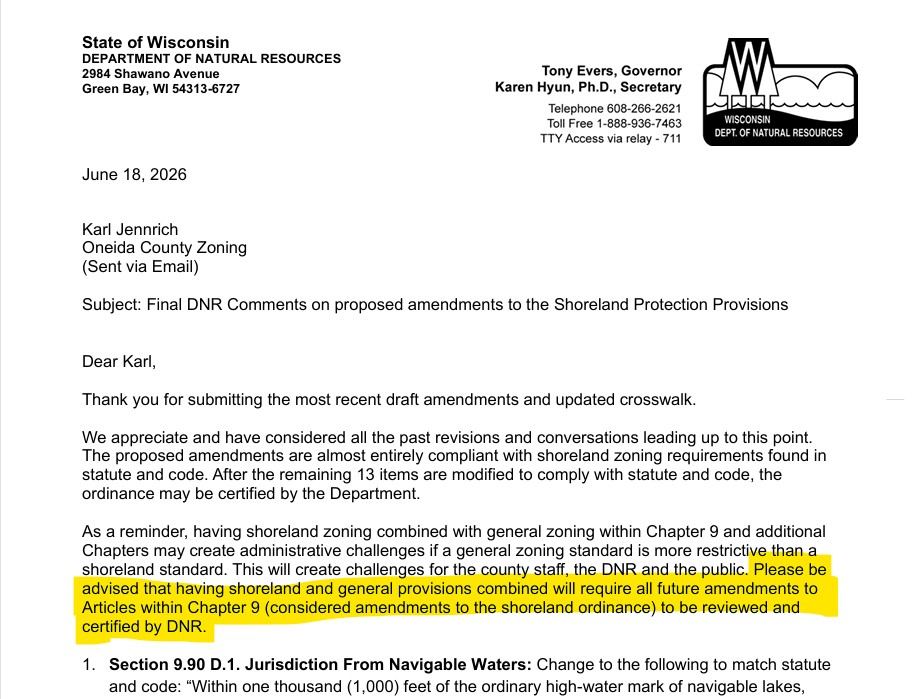
That dispute prompted state regulators to conduct a comprehensive legal audit of Chapter 9. When DNR specialists reviewed the text, they spotted the linking clause and issued a formal ruling: because inland rules are legally incorporated into the shoreland ordinance, any future text amendment across the entire codebook requires state certification. An administrative shortcut from 2000 suddenly locked county-wide zoning updates under state agency oversight.
In its June 18 audit, the Wisconsin DNR formally notified county zoning staff that combining general and shoreline zoning triggered state certification across the entire chapter:
What’s Next: The Final County Board Vote
The Planning and Development Committee recently voted to bypass additional public hearings and send the revised version of Ordinance Amendment #13-2022 straight to the full Oneida County Board of Supervisors for a final vote, which could happen as early as the September county meeting.
Because the committee opted not to hold another public hearing, the full County Board meeting is the final opportunity for citizens to weigh in on the record.
How to Submit Comments for the County Board Meeting
Submit to the County Clerk (Official Packet): Written comments for County Board meetings must be sent directly to Oneida County Clerk Tracy Hartman at
thartman@oneidacountywi.gov. Comments must be received at least two business days prior to the meeting (weekends do not count) to be included in the official supervisors' packet. (Note: If the vote is delayed or postponed to a later month, written comments may need to be re-submitted for the new meeting date.)Speak During Public Comment: Citizens have the right to provide oral testimony during the designated public comment period at the start of the County Board meeting in the County Board Room at the Oneida County Courthouse in Rhinelander.
Contact Your District Supervisor: Because this is a full board vote, decisions will be made by all 21 county supervisors, not just the 5 members of the zoning committee. Contact your town’s district supervisor directly to state your position before they cast their vote.
Key Issues to Address in Your Comments
Building Footprints & Enclosures (Article 10): Request that open wooden decks within the 75-foot shoreline setback remain unenclosed, preventing structures from expanding closer to the water under the guise of an existing footprint.
Setback Averaging (§ 9.94.C): Ask supervisors to ensure setback averaging only applies when both adjacent neighboring homes sit closer than 75 feet, preventing a single outlier property from setting a new baseline.
Buffer Clear-Cutting (§ 9.95): Urge supervisors to protect the 35-foot shoreline buffer by strictly limiting tree clearing and prohibiting the removal of mature trees within viewing corridors.
Six years after an aggressive clear-cutting project on Two Sisters Lake sparked anoutcry, the battle over Oneida County’s shoreline rules is down to a single roll call.
By voting to bypass another public hearing, the Planning and Development Committee has put the final decision directly on the 21 members of the Oneida County Board. When supervisors cast their votes this fall, they will decide whether to pass the disputed waterfront revisions crafted over three years of negotiations, or hold the line established by state regulators and 26 local lake associations. The vote at the courthouse will put every supervisor on the record, settling where Oneida County stands on shoreline protection and local land-use control.
You just read issue #108 of Northwoods Ledger. You can also browse the full archives of this newsletter.