
Oneida County officials spent nearly four years reviewing a proposed shoreline zoning amendment that would have altered how building footprints are calculated near lakes and streams.
The Core Debate: Redefining "Building Footprint"
Under state rules, structures built close to the water before modern zoning laws are called legal nonconforming structures. Current laws limit expanding these buildings within the 75-foot shoreline setback zone to protect nearby lakes and rivers.
The proposal created a new legal definition for "building footprint." It counted open outdoor structures, such as wooden decks, covered porches, eaves, and roof overhangs, as part of the main building footprint. Under this rule, a property owner could enclose an open deck or porch into indoor living space without technically increasing the structure's legal footprint.
Opponents noted that converting open decks into enclosed rooms creates larger buildings near the water and increases stormwater runoff, even if the total footprint area on paper stays the same.
Permit Exemptions and Hardscaping Provisions
In addition to footprint calculations, Ordinance Amendment 13-2022 contained several other proposed updates to county land use regulations:
Permit Exemptions: The proposal aimed to eliminate mandatory county zoning permits for minor waterfront construction and land-altering projects valued under $2,500.
Hardscaping Rules: The draft proposed revised standards for hardscaping within the shoreland zone, including retaining walls, stone patios, walkways, and shoreline access stairways.
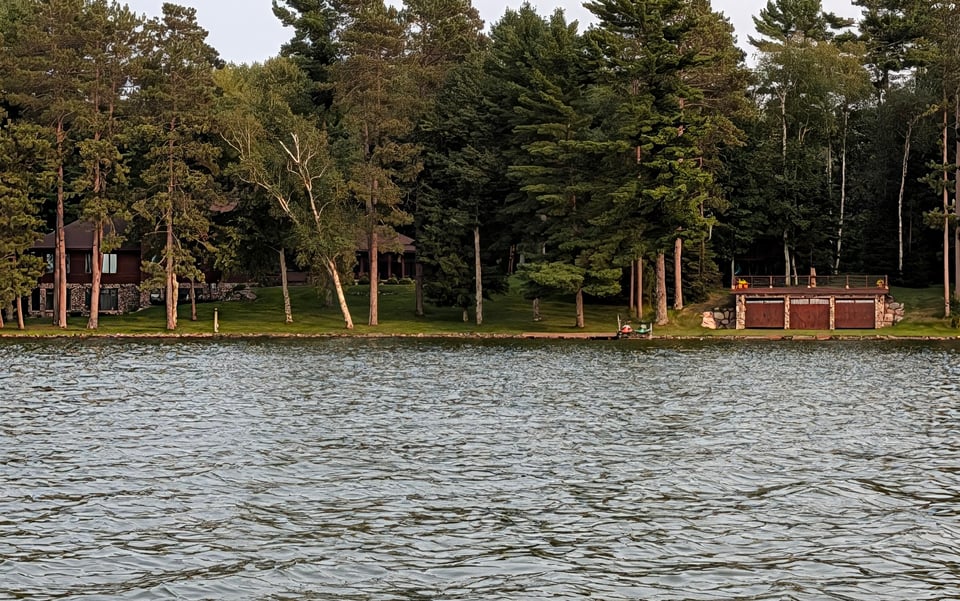
Lakeside structures and cleared lawns meet the water: the core focus of state shoreline zoning rules designed to manage stormwater runoff and protect water quality.
County planning staff framed these updates as administrative modernizations designed to streamline the permitting workflow, reduce minor backlogs, and provide clearer guidelines for waterfront property owners.
The Four-Year Administrative Process
The Planning and Development Committee in Rhinelander initiated its review of the draft amendment in the summer of 2022. Over the following three and a half years, department staff held multiple work sessions to refine the draft text.
Counties are responsible for drafting and enforcing local shoreland ordinances, but draft language must be formally submitted to the DNR for statutory review prior to final enactment to ensure it meets statewide baseline standards.
Public Hearing Testimony and Environmental Concerns
The draft came to a final public hearing on February 24, 2026, drawing significant attendance from local property owners, lake association representatives, and conservation groups, including Oneida County Clean Waters Action (OCCWA).
Opponents presenting testimony focused on how shoreline development affects water quality:
Stormwater Runoff: Enclosing open decks and adding solid roofs creates hard surfaces that block rainwater. Water cannot soak into the ground, so it runs directly into nearby lakes and streams.
Nutrient Loading: Runoff carries dirt, phosphorus, and lawn chemicals into the water. This causes weed growth, algae blooms, and harms local fish.
Vegetation Buffers: Building larger enclosed structures close to the water often leads to cutting down trees and natural plants within the mandatory 35-foot shoreline buffer zone.
Critics also raised concerns regarding the proposed $2,500 permit exemption, arguing that unmonitored earth-moving or hardscaping projects near the shoreline could lead to cumulative erosion issues without county oversight.
State DNR Notice and Legal Override Authority
During the hearing, DNR officials formally entered a written notice into the public record. The agency stated that the proposed footprint definition and permit exemptions dropped below the minimum statewide standards.
The DNR notified the committee that if Oneida County passed the amendment as written, the state would step in, erase the non-compliant county rules, and enforce state standards instead.
On February 24, 2026, Following the DNR’s notice and public testimony, the Oneida County Planning and Development Committee voted unanimously to table the measure indefinitely.
Current Enforcement and Next Steps
With the amendment stalled, Oneida County’s existing shoreline zoning regulations remain fully in effect:
Unenclosed exterior features such as open decks, awnings, or roof overhangs cannot be used to justify converting open area into enclosed indoor living space within the 75-foot setback.
Shoreline projects under $2,500 remain subject to standard county zoning permit requirements and site reviews.
Existing hardscaping restrictions and vegetative buffer requirements within 35 feet of the ordinary high-water mark remain fully enforced.
You just read issue #107 of Northwoods Ledger. You can also browse the full archives of this newsletter.