When a developer divides land into home lots, the biggest expense is usually not buying the land. It is building the road.
Clearing trees, digging drainage ditches, and paving a standard public road costs between $150,000 and $300,000 per section. Under Wisconsin law, that bill is supposed to be paid by the private developer who profits from the project.
In Oneida County, however, developers have found a way around these rules. By utilizing a local waiver clause (Section 15.31(2) of the county subdivision code), developers are bypassing state mandated infrastructure costs and deferring them to the taxpayer.
When Oneida County approves a waiver, it allows a dense residential development to be treated on paper as a minor split, instead of a full subdivision. That wipes out the requirement for paved public roads and financial guarantees entirely.
The real-world consequences of that policy played out at the Oneida County Courthouse on June 24, 2026.
The Little Rice Decision: Overriding the Town Board
At the center of the dispute was an application by developer Andrew Freihage and surveyor Dustin Vreeland (Vreeland & Associates). They petitioned the county to split two properties (Parcels LR-1427 and LR-1428) into four new residential lots in the Town of Little Rice.
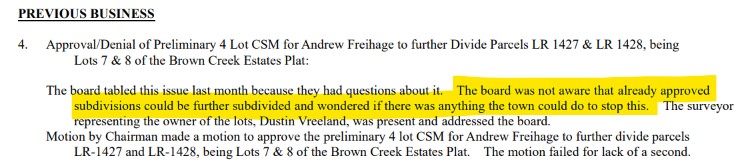
Because of previous land divisions, this new project legally qualified as a formal subdivision. Under state and county law, that classification triggers costly safeguards:
Paving an engineered public road built to carry heavy commercial traffic.
Undergoing comprehensive environmental and drainage audits by state agencies.
Posting cash escrow or surety performance bonds to protect taxpayers before any lot is sold.
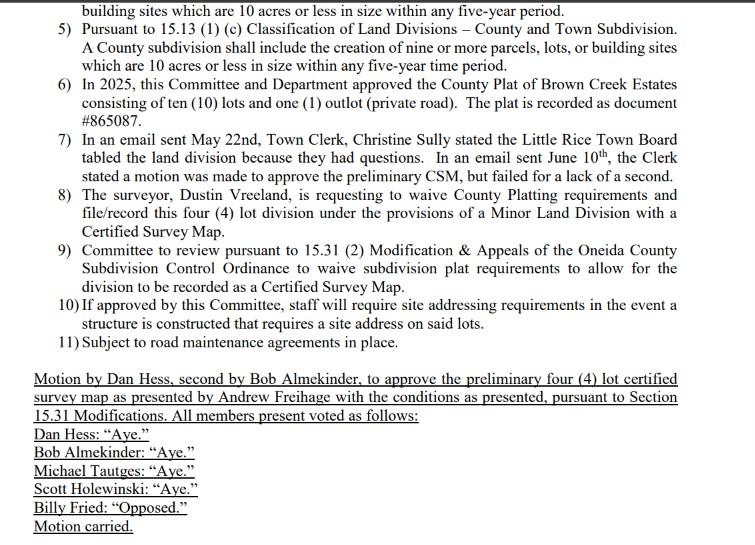
Instead of submitting a formal subdivision plat or engineering a public road, the developer asked the county for a waiver under Section 15.31(2) of the Oneida County Subdivision Control Ordinance.
The Little Rice town board had already reviewed the project and refused to back it, when the proposal came before board earlier in the month.
During the Oneida County meeting, Planning and Zoning specialist Scott Ridderbusch read a letter from Little Rice Town Clerk Christine Sully into the official record, confirming that the town board did not support the split.
Despite the town's formal opposition, the county committee approved the waiver on a 4 to 1 roll-call vote:
Ayes (4): Scott Holewinski (Chair), Dan Hess, Bob Almekinder, Michael Tautges
Nay (1): Billy Fried
Supervisor Dan Hess made the motion to approve the waiver, seconded by Supervisor Bob Almekinder.
Supervisor Billy Fried cast the lone dissenting vote. During deliberations, Fried warned his fellow supervisors that routinely approving § 15.31(2) waivers sets a bad administrative precedent and lets developers bypass basic county road standards.
Why Private Road Agreements Fail
Instead of requiring paved roads and cash bonds, the county conditions § 15.31(2) waivers on the recording of a "Private Road Maintenance Agreement."
These agreements legally require all future lot owners to split the cost of plowing, grading, and gravel. In reality, they offer little protection:
No Municipal Enforcement: Neither Oneida County nor local town boards enforce or mediate private road agreements. If an out-of-town owner refuses to pay their share of an annual plow bill, the remaining neighbors must hire private lawyers and file lawsuits in civil court.
Heavy Construction Damage: The heaviest damage to a road happens right after lots are sold. Concrete mixers weighing 60,000 pounds, gravel trucks, and well-drilling rigs repeatedly run over the unpaved track during home construction.
Year-Round vs. Seasonal Owners: Northwoods developments inevitably mix full-time residents with seasonal cabin owners. Year-round commuters need reliable 5:00 a.m. snowplowing and routine grading. Seasonal owners who visit a few weekends a year frequently refuse to pay for winter plowing. The agreement quickly breaks down into neighborhood disputes.
The Taxpayer Trap
The final breakdown happens years later, after the developer has sold the last lot.
Inevitably, the private gravel road deteriorates beyond what individual property owners can afford to fix. Culverts wash out, winter frosts heave the roadbed, and residents face contractor estimates of tens of thousands of dollars to rebuild the road from scratch.
Unable to fund the repairs privately, homeowners organize, attend a monthly town board meeting, and petition the township to formally take over the private road as a public highway under Wis. Stat. ch. 82 and pave it with tax dollars.
This creates a financial trap for rural town boards:
A rural township operating on a tight road budget cannot rebuild a private road without cutting maintenance on existing public town highways.
This problem is well-known across the Northwoods. Townships like Cassian and Newbold passed ordinances requiring homeowners to pay 100% of engineering and paving costs out-of-pocket before the town will even consider taking over a failing private road. In communities like the Town of Crescent, town boards have simply refused to accept deteriorated private roads like Candy Lane, leaving stranded residents to foot massive repair bills alone.
Support Independent Public Records Reporting
Auditing county committee votes, reviewing municipal correspondence, and tracking local land-use decisions requires consistent watchdog reporting. To support ongoing public records investigations in Oneida County, consider subscribing to The Northwoods Ledger.
You just read issue #112 of Northwoods Ledger. You can also browse the full archives of this newsletter.