
We believe that informed voters are the only defense against fiscal mismanagement and the erosion of local resources. If you are a paid subscriber, thank you for making this work possible.
An industry that generates $394 million a year for Oneida County is slated to receive zero dollars in county marketing support next year.
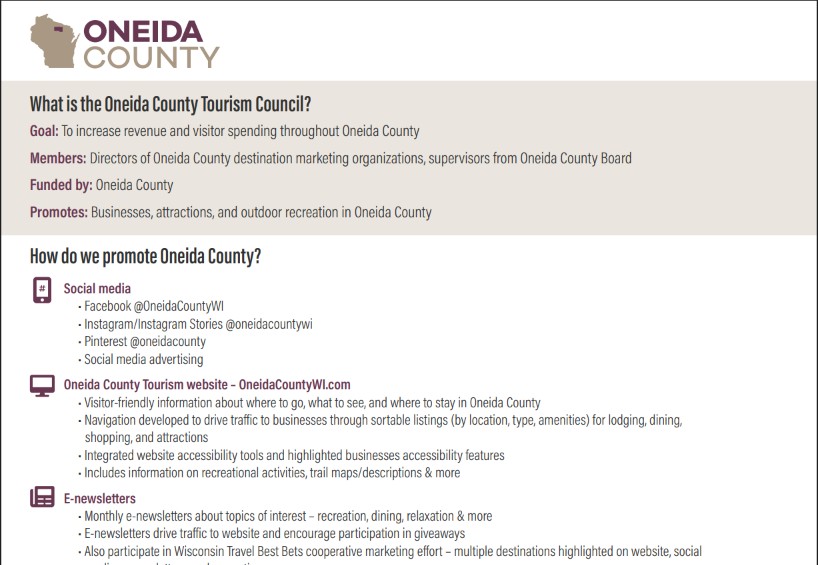
In a 7-0 vote, the Executive Committee eliminated the proposed 2027 budget for the Oneida County Tourism Council (OCTC), opting to use those funds to plug a looming deficit.
The decision prompted immediate public reaction. District 22 Supervisor Steven Schreier questioned the move online, writing, "How important is tourism to Oneida County? $0 According to Executive Committee."
The debate highlighted a fundamental disagreement about who pays for tourism promotion. It also demonstrated exactly how Wisconsin property tax laws are forcing rural counties to choose between community programs and mandatory operations.
The October Budget Timeline
The budget reduction started at the August 26, 2026, Executive Committee meeting. OCTC Chair Jacqui Sharpe and Treasurer Krystal Westfahl requested $92,500, an amount meant to restore their funding after a 30 percent cut during the previous budget cycle.
Committee Chairman Billy Fried opposed the request on the record. He argued that local towns already collect room taxes on hotel and cabin stays to fund their own visitor bureaus. Because of those local collections, Fried called the county funding an unnecessary duplication of services.
Sharpe strongly disputed that reasoning during the hearing, pointing out a major gap in the county's map.
"Fifteen of the 21 communities in Oneida County do not collect a room tax and are not served by a chamber, visitors bureau or other destination marketing organization," Sharpe wrote in a statement to the committee. "Those are the people, businesses and communities that Oneida County Tourism serves."
Rural communities like Enterprise, Monico, Piehl, Stella, and Woodboro have no room tax or local visitor bureaus to promote their businesses. Without county funding, those towns receive no regional marketing support.
Fried initially motioned to drop the OCTC budget to zero, but his motion died without a second. Supervisor Scott Holewinski then offered a compromise of $70,000, which passed in a 4-1 vote.
The compromise did not last. By the October budget reconciliation meetings, the county faced steep cost increases for employee health insurance. Looking to balance the ledger, the committee abandoned the $70,000 compromise and voted unanimously to eliminate the tourism line item entirely.
Yet the committee treated other non-mandatory programs differently during the exact same hearings. While eliminating the $92,500 tourism line item, supervisors approved $146,500 for the Oneida County Economic Development Corporation and $197,081 for the Rhinelander-Oneida County Airport.
The UW-Extension Comparison
The Tourism Council was not the only discretionary program facing elimination this fall.
During preliminary hearings, the committee also moved to cut the Oneida County UW-Extension's requested $135,000 allocation. That reduction would have ended local 4-H programs, Teen Court, and FoodWise safety classes.
Unlike the Tourism Council, however, the UW-Extension had a highly organized group of local supporters. Residents contacted committee members and attended hearings to demand that supervisors protect the department. Following that public outcry, the committee reversed course and restored $125,000 for the UW-Extension. The Tourism Council did not see a similar public mobilization before its final vote.
The Statutory Squeeze
At its core, the county's budget crisis is rooted in a state law known as Wisconsin Statute § 66.0602.
This statute caps how much local governments can raise property taxes each year. Under state rules, tax growth is tied directly to a formula called "net new construction." In growing southern Wisconsin counties, new housing developments allow property tax collections to grow naturally. In rural, heavily forested counties like Oneida, new building construction is very low. As a result, the county's tax revenues stay essentially flat.
When costs rise for required services like snowplows, road salt, jail operations, or sheriff patrols, supervisors cannot simply raise property taxes to cover the bills. State law requires counties to fund mandatory services first. Discretionary programs like tourism marketing must compete for whatever funding is left.
The Revenue Debate: Sales Tax vs. Property Tax
With county funding on the chopping block, Sharpe suggested another option. She proposed paying the $92,500 request using county sales tax receipts instead of the property tax levy. Because visitors generate 20 percent of all local sales tax, Sharpe argued that using sales tax would solve the budget problem.
In practice, however, that move does not create any new money. Under Wisconsin Statute § 77.70, all county sales tax revenue must go directly toward lowering the local property tax burden. The county already counts every expected sales tax dollar in its general budget to keep overall taxes below state-mandated caps.
Diverting $92,500 in sales tax to the Tourism Council simply leaves a $92,500 hole in the rest of the budget. That shortfall would directly hit required services like road repairs, patrols, and county health plans. Because state law prevents the county from raising property taxes to replace that money, supervisors would still have to cut $92,500 from another department.
The North-South Divide
This budget fight also exposes a deep geographic division within Oneida County.
Rhinelander is the county seat. Its local economy relies heavily on manufacturing, paper production, and year-round industrial employment.
In contrast, the Lakeland communities to the north, including Minocqua and Woodruff, depend on resorts, lake cabins, and seasonal visitors. Over the last decade, the rapid growth of short-term vacation rentals in those northern towns has driven up property valuations, shifting a larger share of the overall county tax burden onto lakefront property.
When supervisors review a tourism marketing budget, the debate centers on fairness. Rhinelander residents question why their tax dollars should pay for regional advertising that primarily benefits resort owners and commercial lodging in the northern towns.
The Regional Baseline: Vilas County
Oneida County's budget decision contrasts sharply with neighboring Vilas County. Both counties share a similar Northwoods tourism economy. According to 2025 Wisconsin Department of Tourism data, Oneida County saw $394 million in visitor spending, while Vilas County recorded $383 million.
Despite those nearly identical numbers, the two county boards approach marketing differently. Vilas County budgets approximately $125,000 annually for county-level tourism advertising, even though 14 of its 15 towns also collect local municipal room taxes. Oneida County proposes spending zero dollars.
Vilas County leaders treat their marketing allocation as a regional umbrella that keeps their towns competitive against other vacation destinations. Oneida County leaders view it as a duplicated expense that taxpayers cannot afford during a budget deficit.
We believe that informed voters are the only defense against fiscal mismanagement and the erosion of local resources. If you are a paid subscriber, thank you for making this work possible.
The Procedural Road Ahead
The 7-0 committee vote is not the final word on the budget. Under Wisconsin Statute § 65.90, the full 21-member Oneida County Board of Supervisors must review and adopt the final county budget in November 2026.
To restore funding for the Tourism Council, an amendment must be introduced on the board floor. Passing that amendment will require a simple majority of 11 votes.
Supervisors who support the funding will argue that cutting advertising hurts the county's primary economic engine and abandons the rural towns that have no local chambers. Supervisors who oppose the funding will point out that adding $92,500 back into the budget requires cutting the exact same amount from another county department.
When the full board meets in November, the 21 supervisors will ultimately decide whether regional marketing is an essential county investment or an unaffordable luxury.
======================================================================
PUBLIC HEARING: HOW TO WEIGH IN ON THE 2027 BUDGET
======================================================================
* WHEN: Tuesday, November 10, 2026, at 9:30 a.m.
* WHERE: Oneida County Courthouse, County Board Room (Second Floor)
1 S. Oneida Ave., Rhinelander, WI 54501
* WHO CAN SPEAK: Any county resident or taxpayer. Speakers step forward, state their name and township, and address the full 21-member board.
======================================================================
You just read issue #124 of Northwoods Ledger. You can also browse the full archives of this newsletter.