
Representation, Local Budgets, and the Future of Our Woods and Waters
Election Date: Tuesday, November 3, 2026
What Is at Stake This Fall
On Tuesday, November 3, 2026, voters across Oneida, Vilas, and Lincoln counties will head to the polls. This election will shape state policy in Madison, federal representation in Washington, and leadership in our community.
This fall, voters face big decisions on:
The State Assembly: Three contested legislative seats representing northern Wisconsin.
The U.S. House of Representatives: An open seat in Wisconsin’s 7th Congressional District.
Three Statewide Constitutional Amendments: Proposed changes to state powers over taxes, emergency rules, and public programs.
County Offices: Races for county sheriff, clerk of court, and coroner.
Local Town Referendums: Key advisory votes on road maintenance and town spending.
Local governments across the Northwoods face mounting financial pressure. Federal pandemic relief money from the American Rescue Plan Act (ARPA) expired at the end of 2025. Without that federal cushion, town and county boards must balance their budgets under state property tax caps. At the same time, our regional economy, which relies on outdoor recreation, seasonal visitors, and working timberlands, depends on clean lakes, productive forests, and safe drinking water.
Regional Overview: Tight Budgets and Fragile Waters
Under Wisconsin law, towns and counties cannot raise local property taxes for daily operations by more than the rate of net new construction built that year. Across rural northern counties, new building growth averages roughly 1 percent per year. While annual property tax growth stays near 1 percent, Wisconsin Department of Transportation data shows the cost of asphalt and road construction has risen by more than 5 percent per year over the last five years. Because road and equipment costs are climbing five times faster than allowed tax revenue, counties struggle to pay for snowplows, 911 dispatch centers, and employee health insurance.
County Budget and Infrastructure Pressures
Oneida County (Estimated New Construction: 1.15 percent): The county left a regional tri-county human services partnership to run its own social services department. Since that transition, rising costs for foster care and youth residential placements have created an annual deficit of more than $825,000. That shortfall drains cash reserves, delays paving projects, and leaves the county operating out of a 70-year-old highway shop. County budget pressures also led the Oneida County Executive Committee this fall to debate cutting the county's $135,000 UW-Extension budget. Voters can review county budget records through the official Oneida County Finance Department portal.
Vilas County (New Construction: 1.28 percent): Lakefront property values have climbed, but state levy limits stop the county from using higher property assessments to pay for rising operating costs. To fund daily services, Vilas County relies on $4.375 million in seasonal sales tax revenue and borrowed $5 million in bond debt to repave county roads.
Lincoln County (New Construction: Under 1.00 percent): Facing depleted health insurance reserves and the end of federal ARPA funds, the county transferred $2.8 million out of its solid waste landfill fund to cover a cash shortage. To replace that money, the board borrowed $4 million in bond debt. The county now pays $775,900 per year in debt service, which drove a 6.78 percent property tax increase for residents.
Reporter's Notebook: How County Borrowing Bypasses the 1 Percent Tax Cap Voters often ask how Lincoln County property taxes rose 6.78 percent when state law caps annual operating tax increases near 1 percent. When a county board issues bonds to borrow money, the annual payments on that debt are added on top of the property tax bill. Borrowing millions of dollars to pave roads or refill drained accounts raises local property taxes right away.
Natural Resources Under Pressure These budget challenges overlap with three major environmental debates moving from local town halls to the state Capitol:
Metallic Sulfide Mining: Exploration near the Lynne Deposit in Oneida County sits near the Willow Flowage, which is designated by the state as an Outstanding Resource Water.
PFAS Contamination: Municipalities including Rhinelander and Merrill continue working to remove toxic forever chemicals from public drinking water systems.
Wake Boats: Shoreline erosion, lake bottom scouring, and ballast water transfers between lakes have prompted local calls for state boating rules.
Statewide Executive: Wisconsin Governor
Wisconsin voters will elect a new governor this fall following the decision by incumbent Governor Tony Evers not to seek re-election. The governor serves a four-year term, directs cabinet agencies including the Department of Natural Resources and Department of Transportation, and holds line-item veto power over state budget bills passed in Madison.
Tom Tiffany (Republican)
Tiffany represented the Northwoods in the Wisconsin State Assembly and State Senate before his election to the U.S. House of Representatives. Before entering public office, he ran Wilderness Cruises and served as a dam tender on the Willow Flowage in Oneida County.
Taxes and Local Budgets: Tiffany focuses on cutting state spending, lowering income taxes, and reducing regulations on agriculture, logging, and small businesses. He advocates for a statewide property tax freeze to protect homeowners from rising assessments. On local government, Tiffany maintains that towns and counties must live within state levy limits rather than seeking tax hikes or taking on debt.
Mining and Natural Resources: Tiffany is one of the state's leading advocates for mineral extraction. While in the State Senate, he authored the 2017 law that repealed Wisconsin's 1997 "Prove-It-First" sulfide mining moratorium. Tiffany argues that copper, zinc, and critical mineral deposits offer family-supporting jobs in rural Wisconsin. He contends that modern engineering and technical DNR reviews can safeguard groundwater without blanket bans, and he supports active timber harvesting on public forestlands.
David Crowley (Democrat)
Crowley has served as Milwaukee County Executive since 2020 and previously served two terms in the Wisconsin State Assembly. As county executive, he negotiated bipartisan agreements with state leaders to modernize local sales tax laws and stabilize public pensions.
Taxes and Local Budgets: Crowley centers his platform on state investment in public schools, healthcare access, and municipal budgets. He argues that state-imposed levy caps have starved rural towns and counties of basic funding. Crowley supports increasing state shared revenue so local governments can repair county highways, run emergency services, and fund public nursing homes without issuing debt.
Mining and Natural Resources: Crowley prioritizes clean drinking water and wetland conservation. He opposes metallic sulfide mining near sensitive watersheds like the Willow Flowage, arguing that runoff and acid mine drainage pose long-term threats to the Northwoods outdoor tourism economy. Crowley advocates for restoring strict environmental review standards, respecting tribal treaty rights in permitting decisions, and funding state grants to remove PFAS contamination from municipal water wells.
The Choice
Tiffany offers a platform centered on tax cuts, spending caps, regulatory relief, and domestic mineral extraction to spur rural economic growth. Crowley offers a platform focused on increased state aid for local public services, public school funding, and environmental regulations to protect freshwater lakes and drinking supplies.
State Legislative Races: Wisconsin Assembly
Following statewide redistricting, voters across the Northwoods will cast ballots in contested State Assembly races. Because district lines vary by township and ward, voters should use the official interactive district lookup tool on MyVote WI What's On My Ballot to confirm which Assembly race appears on their local ballot based on their residential address.
Rob Swearingen (R, Incumbent) vs. Merlin Van Buren (D, Challenger)
Rob Swearingen (Republican, Incumbent): Swearingen has served in the State Assembly since 2013. A former restaurant owner and past president of the Tavern League of Wisconsin, he focuses on lowering taxes, supporting small businesses, and reducing state regulations. In Madison, Swearingen advocates for the tourism and hospitality industries. He supports state road funding to handle visitor traffic while opposing higher corporate taxes and state energy mandates. On environmental policy, Swearingen argues that state rules must protect private property rights and commercial investment.
Merlin Van Buren (Democrat, Challenger): Van Buren serves on the Rhinelander School District Board of Education and works as a purchasing agent. His campaign focuses on public school funding and water protection. Van Buren argues that state funding formulas shortchange rural schools, forcing communities to rely on local property tax referendums to keep classrooms running. He calls clean lakes and safe drinking water the region's most important economic assets, supporting state funding for municipal PFAS cleanup, limits on wake-boat ballast water, and restrictions on metallic sulfide mining near local waterways.
The Choice: Swearingen argues that economic growth comes from lower taxes and fewer business regulations. Van Buren contends that underfunded rural schools and polluted waterways threaten property values and the local economy.
Calvin Callahan (R, Incumbent) vs. Elizabeth McCrank (D, Challenger)
Incumbent Calvin Callahan of Tomahawk faces challenger Elizabeth McCrank of Merrill.
Calvin Callahan (Republican, Incumbent): Callahan entered the Assembly in 2021 after serving on the Lincoln County Board and the Tomahawk City Council. He chairs the Assembly Consumer Protection Committee and focuses on tax cuts, state spending limits, and law enforcement funding. Callahan argues that the state can best help families and businesses deal with inflation by restraining government budgets. He maintains that towns and counties should operate within existing state levy caps rather than raising taxes or taking on new debt.
Elizabeth McCrank (Democrat, Challenger): McCrank serves as a supervisor on the Lincoln County Board. Her campaign centers on rural healthcare, public schools, and county budget relief. On the county board, McCrank opposed selling the county-owned Pine Crest Nursing Home, arguing the question belonged on a voter referendum. She argues that state levy limits have starved rural counties while Madison held back shared revenue, and she supports state aid for rural nursing homes, mental health programs, and early childhood care.
The Choice: Callahan favors state spending caps and private-sector management to hold down taxes. McCrank views county roads and public nursing homes as community services that require stronger state revenue sharing.
Jeffrey Mursau (R, Incumbent) vs. Shena Chapman (Independent, Challenger)
Incumbent Jeffrey Mursau of Crivitz faces Independent challenger Shena Chapman. No Democratic candidate is on the ballot in this race.
Jeffrey Mursau (Republican, Incumbent): Mursau has served in the Assembly since 2005 and chairs the Assembly Forestry, Parks and Outdoor Recreation Committee. His campaign emphasizes his legislative seniority and support for the timber industry, rural manufacturing, and hunting and fishing access. Mursau backs active timber harvesting on public lands to supply local loggers and paper mills alongside regulatory relief for forestry and farming operations.
Shena Chapman (Independent, Challenger): Chapman has worked as a home health caregiver, school paraprofessional, bank teller, and small business owner. Running without party affiliation, her campaign focuses on clean drinking water, public schools, and government transparency. Chapman argues that state lawmakers have moved too slowly on industrial PFAS contamination in northeastern Wisconsin. She supports corporate pollution accountability, state grants to help small towns filter drinking water, and added funding for local emergency responders.
The Choice: Mursau brings two decades of legislative seniority and close ties to the forestry and paper industries. Chapman offers an independent campaign focused on PFAS water cleanup, public schools, and working families.
Federal Representation: U.S. House of Representatives
Northern and central Wisconsin voters will elect a new member of Congress to fill the open seat left by Republican Representative Tom Tiffany, who stepped down to run for governor. Voters can verify their congressional district by residential address using the official lookup tool at MyVote WI What's On My Ballot.
Michael Alfonso (Republican): With roots in Vilas County and Wausau, Alfonso earned a mathematics degree from UW-Madison, worked in concrete and road construction while living in Hayward, and later served as producer of The Dan Bongino Show. He is endorsed by President Donald Trump, U.S. Transportation Secretary and former Congressman Sean Duffy, Oneida County Sheriff Grady Hartman, and former Vilas County Sheriff Joseph Fath. Alfonso argues that federal spending and regulations drive up prices for fuel, groceries, and housing. He supports expanding domestic oil and gas drilling, cutting federal spending, and rolling back federal rules on family farms and loggers.
Fred Clark (Democrat): Clark lives in Bayfield and is a forest ecologist, business owner, conservation executive, and former State Representative. His campaign focuses on natural resource management, rural healthcare, clean water infrastructure, and workforce housing. Clark argues that national forests should be managed to balance timber harvests with clean water and outdoor recreation. He supports targeted federal grants to help rural towns upgrade drinking water plants, expand broadband internet, and keep rural hospitals open.
The Choice: Alfonso views federal spending and agency rules as barriers to local business, housing affordability, and energy production. Clark views federal grants and public land stewardship as necessary tools to support rural hospitals, water systems, and working forests.
County Constitutional Offices: Uncontested Ballots
Every county constitutional office on the ballot across Oneida, Vilas, and Lincoln counties is uncontested this fall. While county boards set the annual budget for each department, the County Sheriff, Clerk of Circuit Court, and Coroner hold independent statutory authority over daily staffing and department operations.
Oneida County
Sheriff: Grady Hartman (Republican, Incumbent, serving since 2013).
Clerk of Circuit Court: Brenda Behrle (Republican, Incumbent).
Vilas County
Sheriff: Gerard T. Ritter (Republican, Incumbent, appointed in 2025 following the retirement of Sheriff Joseph Fath).
Clerk of Circuit Court: Beth A. Soltow (Republican, Incumbent).
Lincoln County
Sheriff: Andy VanderWyst (Republican, Patrol Lieutenant and Investigator running to succeed retiring Sheriff Ken Schneider).
Clerk of Circuit Court: Thomas Barker (Republican, Incumbent).
Coroner: Valerie Caylor (Republican, Incumbent).
What Uncontested Races Mean for Taxpayers
Law enforcement is typically the single largest operational expense in a county budget. Without contested campaigns, major policy decisions over patrol schedules, jail staffing, and squad car replacements take place inside county committee meetings rather than public candidate forums:
Oneida County: Sheriff Grady Hartman and the county board must weigh public safety requests against an $825,000 social services deficit and delayed highway projects. Residents can follow oversight meetings through the Oneida County Public Safety Committee.
Vilas County: Sheriff Gerard T. Ritter leads a department balancing heavy summer road and boat patrol demands against a 1.28 percent operating tax cap. Departmental oversight is handled by the Vilas County Law Enforcement and Emergency Management Committee.
Lincoln County: Incoming Sheriff Andy VanderWyst will take office after a $239,000 drop in revenue from housing outside inmates contributed to the county's budget shortfall. With the county paying $775,900 per year on bond debt, sheriff's department spending is reviewed monthly by the Lincoln County Law Enforcement Committee and the Administrative and Executive Committee.
Statewide Constitutional Amendments and Local Referendums
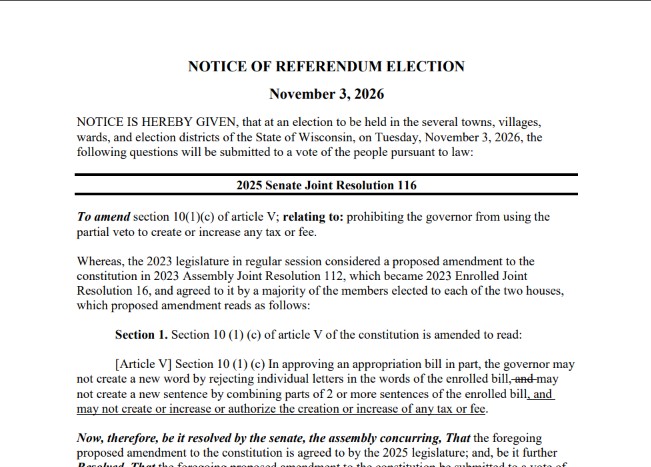
Wisconsin voters will decide three proposed amendments to the Wisconsin Constitution this fall. Constitutional amendments must pass two consecutive sessions of the state legislature and do not require the governor's signature; if approved by a majority of voters, they become permanent parts of the state constitution. Voters can read the complete official ballot text and explanatory statements on the Oneida County Referendum Notice.
Question 1: Limiting the Governor's Partial Veto Power (SJR 116)
Wisconsin governors hold broad partial veto authority on state budget bills, allowing them to strike out individual words, digits, and dollar amounts. In 2023, Governor Tony Evers used this power on a budget clause that raised public school revenue limits by $325 per student through the "2024-25" school year. By striking the "20", the hyphen, and the space, Evers changed the text to read "2425", extending the school funding increase for 400 years. After the Wisconsin Supreme Court upheld that veto in 2025, lawmakers placed SJR 116 on the ballot.
A "Yes" vote amends Article V, Section 10(1)(c) of the Wisconsin Constitution to prohibit the governor from using a partial veto to create or increase any tax or fee.
A "No" vote keeps the governor's current partial veto authority unchanged.
The Debate: Supporters argue the amendment stops governors from creating long-term tax hikes that lawmakers never approved. Opponents argue the partial veto is an important check that allows a governor to protect school and local government funding when the legislature deadlocks.
Question 2: Places of Worship During Emergencies (AJR 10)
Growing out of debates over public gathering limits during the COVID-19 pandemic, AJR 10 proposes adding new language to the religious liberty clause in Article I, Section 18 of the Wisconsin Constitution.
A "Yes" vote amends the state constitution to prohibit the state or any local government from ordering the closure of, or forbidding gatherings in, places of worship during a declared state of emergency, including a public health emergency.
A "No" vote leaves the state constitution unchanged.
The Debate: Supporters argue that constitutional religious freedom must be protected from government shutdown orders during emergencies. Opponents argue that carving out a permanent constitutional exemption prevents state and local health officers from halting the spread of contagious disease during a public health crisis.
Question 3: Prohibiting Governmental Discrimination and Preferential Treatment (AJR 102)
Proposed under AJR 102, this measure would create Article I, Section 27 of the Wisconsin Constitution governing public employment, public education, public contracting, and public administration.
A "Yes" vote adds a constitutional ban prohibiting state and local government entities from discriminating against, or granting preferential treatment to, any individual or group based on race, sex, color, ethnicity, or national origin (while preserving actions required to maintain eligibility for federal funds).
A "No" vote declines to add this provision to the state constitution.
The Debate: Supporters contend that government hiring, university admissions, and public contracts should be merit-based without group preferences. Opponents note that discrimination is already illegal under state and federal law and argue that banning undefined "preferential treatment" could spark lawsuits against outreach, scholarship, and contracting programs.
Local Referendums in Lincoln County
Voters in two Lincoln County townships will also decide local ballot questions, with notices available on the Lincoln County Election Headquarters website:
Town of Harrison Road Referendum: Voters in the Town of Harrison will weigh in on an advisory referendum concerning town road maintenance and county costs. Following Lincoln County's bond borrowing and property tax increase, town leaders are seeking voter input on directing local tax dollars toward town road paving rather than centralized county expenses.
Town of Corning Clerk Referendum (
Ordinance No. 2026-08-1): As posted on the official Town of Corning Website, voters in the Town of Corning will decide whether the office of Town Clerk should be appointed by a majority of the town board (Yes) or remain an elected position (No).
The Three Pillars of Northwoods Stewardship
Three core issues connect the races and ballot questions in this guide:
Responsible Budgets: Sound local finance means paying for everyday services with reliable annual revenue rather than drained reserve funds or long-term bond debt. With federal ARPA funds gone, state lawmakers must decide whether to adjust local levy limits or increase state shared revenue so rural towns and counties can maintain roads and emergency services.
Protecting Our Waters and Forests: Northern Wisconsin's economy depends on clean water and healthy timberlands. State and federal lawmakers hold the power to set rules on metallic sulfide mining near the Willow Flowage, fund municipal PFAS treatment, and address shoreline damage from wake boats.
Accountability and Citizen Voice: When county offices run uncontested, budget and policy decisions happen inside committee rooms. Contested legislative races, ballot referendums, and public county committee meetings give Northwoods residents the tools to hold local government accountable.
Voter Resources and Election Information
Specific voting regulations, registration rules, identification requirements, and polling place operating hours are managed by state and local election authorities. Voters across the Northwoods can verify their registration status, locate their polling place, and review sample ballots through these official portals:
Statewide Voter Portal (MyVote WI): Operated by the State of Wisconsin Elections Commission, this official
.govportal provides an interactive Polling Place Finder for confirmed operating hours and locations, a Sample Ballot and District Lookup tool by residential address, Voter Registration and Eligibility Information, and Voter Record Lookups.Oneida County (Oneida County Election Information): Official
.govcounty portal with municipal sample ballots, referendum notices, and county election contact details.Vilas County (Vilas County Election Information): Official
.govcounty portal offering sample ballots, election notices, and municipal clerk guidance.Lincoln County (Lincoln County Election Headquarters): County election portal featuring candidate listings, sample ballots, polling place notices, and town referendum documents.
You just read issue #123 of Northwoods Ledger. You can also browse the full archives of this newsletter.