
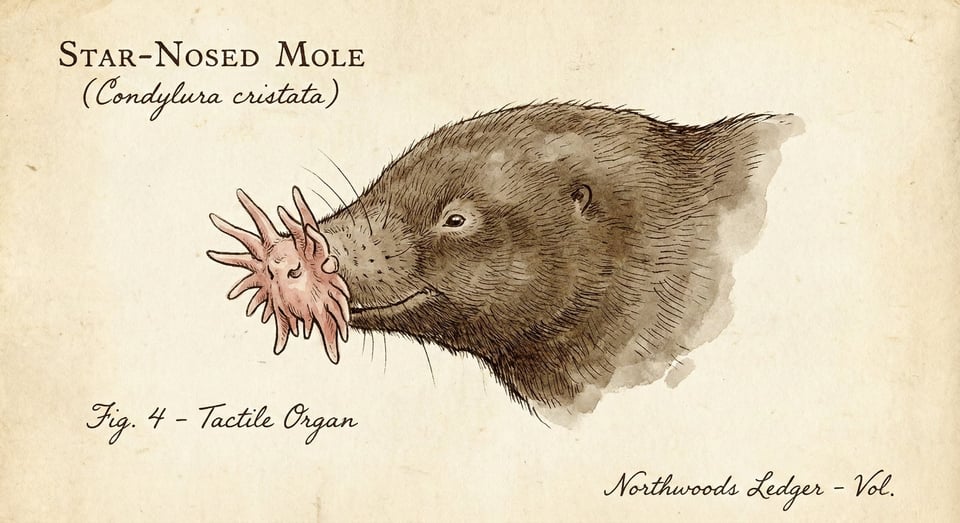
While the Eastern Mole prefers the dry, upland soils of our gardens, a far more specialized relative haunts the wet margins of Northern Wisconsin. In the mucky soils of our stream banks and lake borders, the Star-nosed Mole (Condylura cristata) operates as a pinnacle of sensory evolution. Often dismissed as a mere pest, this species possesses the most sensitive touch organ of any mammal, functioning with a speed that challenges the limits of neurobiology.
A Retina Made of Touch
The most striking feature of the mole is the "star" surrounding its nostrils. 22 fleshy, pink rays that act less like a nose and more like a high-resolution eye. This structure is packed with 25,000 to 30,000 specialized sensory receptors known as Eimer’s organs. To put that in perspective, a human hand contains roughly 17,000 touch receptors. The mole manages to cram nearly double that sensory power into an area smaller than a fingertip.
Research indicates the star functions identically to a visual retina. It features a "fovea", a central area of high acuity on the 11th pair of rays. As the mole forages, it samples the substrate 10 to 12 times per second. Its brain processes this data with visual-like efficiency, building a high-resolution textural map of the dark tunnels. It does not just feel its way through the mud; it "sees" the subterranean world through seismic and textural patterns.
The 120-Millisecond Hunter
The processing speed of the mole's nervous system makes it the fastest eater on Earth. High-speed videography reveals that the mole can identify prey, coordinate a motor response, and consume the item in as little as 120 milliseconds.
Consider these benchmarks:
Human visual reaction time: 250 milliseconds.
Mole decision-to-eat time: 8 milliseconds.
This extreme speed is a vital adaptation for life in the cold Northwoods wetlands. To maintain its body temperature in frozen soils, the mole must consume massive quantities of food. By reducing "handling time" to a fraction of a second, the mole makes hunting small, low-calorie larvae energetically profitable—a feat impossible for slower predators.
Underwater Olfaction: The Bubble-Sniffing Trick
Perhaps the most remarkable capability of the Star-nosed Mole is its ability to smell underwater, a feat previously thought impossible for mammals. Conventional olfaction requires molecules to be airborne. The mole circumvents this through a mechanical behavior called "bubble-sniffing."
When submerged in our local marshes, the mole exhales air bubbles onto an object. These bubbles absorb odorant molecules from the water. The mole then rapidly re-inhales the bubbles, bringing the chemical signature directly to its olfactory receptors. This allows the mole to track prey trails in murky benthic zones, even under the cover of winter ice.
A Resident of the Frozen Muck
In Wisconsin, this species is primarily a resident of the northern half of the state. While they are widespread, they remain elusive due to their sub-aquatic and subterranean lifestyle. They are most active during the months when our landscape is locked in ice, foraging beneath the surface in a world completely inaccessible to humans.
For the Northwoods naturalist, a sighting is rare, usually limited to winter tracks near open water or an occasional encounter near a stream bank. They serve as a reminder that some of the most sophisticated technology in the natural world is operating right beneath our boots, in the very muck we often overlook.
You just read issue #54 of Northwoods Ledger. You can also browse the full archives of this newsletter.