
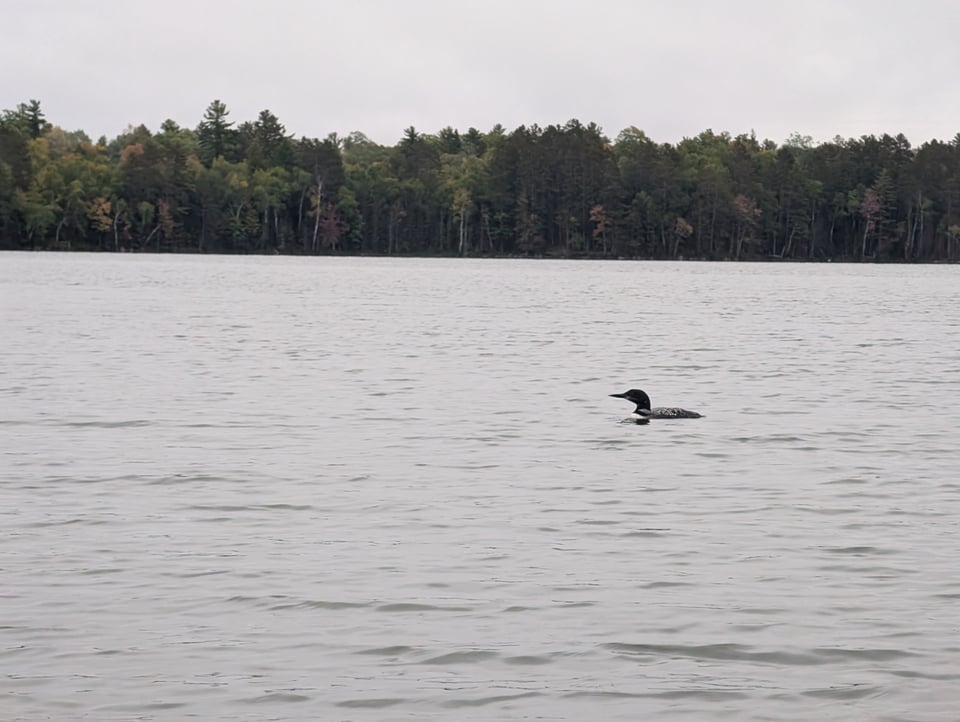
A summer in the Northwoods is defined by a few reliable constants: the smell of pine, the cool water, and the distant call of a loon. For residents and visitors alike, that sound is a sign that our lakes are still wild and healthy. But thirty years of data from our own backyard shows that this constant is slipping away. A combination of changing water chemistry and a lapse in state support has put our most iconic species on a path toward silence.
The 10 Percent Reality
For three decades, Oneida and Vilas counties have served as the world’s most important laboratory for loon behavior. But the latest findings are a gut punch. In the 1990s, nearly 50 percent of the chicks born on our lakes returned here as adults. Today, that return rate has plummeted to just 10 percent.
We are currently witnessing a population that is no longer replacing itself. To understand why, we have to look at the one month that determines a loon's entire life: July.
The Silver Spoon and the Starvation Window
Biologists refer to a "silver spoon" as the environmental head start a chick receives at birth. For a loon, that head start is crystal clear water.
Loon chicks hatch in late June and enter a high speed growth phase in July. They have a narrow four week window to build the muscle mass required to fly to the Gulf of Mexico by autumn. Because loons are visual hunters that must see their prey to catch it, water clarity is their only lifeline.
The Advantage: In clear water, parents easily find high protein fish. The chick hits its target weight and gains the "startup capital" needed to survive its first migration.
The Deficit: Over the last 25 years, heavier July rain events have begun flushing Dissolved Organic Matter into our lakes. This turns the water the color of dark tea.
When the water "browns" during that critical July window, the parents go blind. They struggle to find fish, the chicks starve in plain sight, and those birds leave our lakes too weak to ever make it back.
A Failure of Funding
This discovery was made by Dr. Walter Piper, whose team has monitored over 100 of our lakes since the early 1990s. But now, the very research needed to solve this problem is being forced off the water in Wisconsin.
The crisis is a direct result of shifting priorities. For decades, the National Science Foundation provided the backbone of this study, but federal grants have now moved toward "novel" laboratory science, leaving long term field studies like this one out in the cold. Furthermore, while the State of Minnesota recently stepped up to fully fund the research on their side of the border through 2028, the State of Wisconsin has failed to provide similar support.
Because Minnesota’s funds are legally restricted to their own lakes, that money cannot pay for a single gallon of gas or a student stipend in Oneida or Vilas County.
The $60,000 Bridge
The survival of the Wisconsin study depends on a $60,000 shortfall. This is the precise cost of a field season in the Northwoods. It covers the student researchers who do the night netting and banding, the boat maintenance, and the monitoring of the very lakes we live on.
We can control our shorelines by planting native buffers to filter the runoff that browns our water. We can advocate for water quality standards that protect the "July window." But we cannot solve a problem that we are no longer measuring.
How to Help: Direct contributions to The Loon Project are now the primary funding source for the 2026 Wisconsin field season. You can track the daily field notes and find the donation portal at loonproject.org.
You just read issue #49 of Northwoods Ledger. You can also browse the full archives of this newsletter.