The Butcher's Territory: Identifying Oneida County’s Winter Assassin
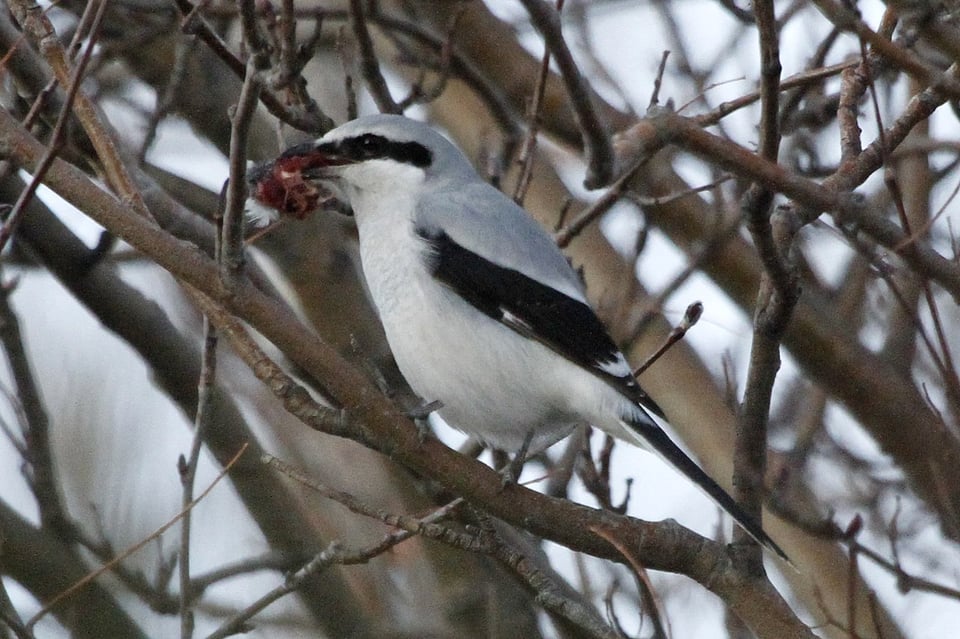
The Northern Shrike is a master of deception. It wears the soft gray plumage and "bandit mask" of a songbird, but its behavior is pure predator. Known as the "Butcher of the Northwoods," this winter visitor transforms our frozen marshes into specialized hunting grounds.
How the Northern Shrike Hunts Without Talons
Unlike hawks or owls, the Northern Shrike lacks heavy talons to crush its prey. It compensates for this lack of hardware with a brutal use of the landscape.
The Shrike strikes mice or small songbirds in the deep snow, carrying the catch to a hawthorn tree, a wild plum thicket, or a strand of barbed wire. It drives the carcass onto a sharp point to anchor the meal. This allows the bird to use its hooked beak to tear away pieces of meat.
The Science of the "Larder"
Biologists call these spiked kill sites "larders." During subzero Wisconsin nights, these caches serve as critical calorie reserves. A frozen vole pinned to a fence post is more than just a meal; it is a border marker. If you find a spiked kill in the brushy edges of the American Legion State Forest, you are standing in a Shrike’s established winter territory.
Where to Spot Oneida County’s Shrikes
While southern Wisconsin spots like the historic Faville Grove Sanctuary are famous for Shrike research, Oneida County residents can find high activity much closer to home.
The "sweet spot" for a sighting is a transitional edge. Look for areas where a thick cedar swamp or brushy marsh meets an open field or a power line clearing. High-activity zones this month include:
Highway 47 Corridors: The shrub-swamp edges along this route provide the perfect mix of cover and perches.
The Willow Flowage: The lowlands and marshes near the water offer high densities of voles.
Hazelhurst Backroads: Quiet, fence-lined fields are prime real estate for territory owners.
Northern Shrike Fast Facts
Scientific Name: Lanius borealis
Winter Habitat: Open fields, brushy edges, and power line clearings.
Diet: Voles, mice, and songbirds like chickadees.
Defining Feature: A black "bandit mask" across the eyes.
https://www.flickr.com/photos/pauljhurtado/8343593195/
You just read issue #39 of Northwoods Ledger. You can also browse the full archives of this newsletter.