In the late 1800s, the Northwoods was filled with loggers, trappers, and railroad workers, but hardly any women. Isolated in rough frontier towns, men turned to an unusual solution: mail order brides.
History Deep Dive: The Mail-Order Brides of the Northwoods
The Business of Matrimony in the Logging Era
If you look at the census records of Northern Wisconsin from the 1880s, you notice a stark demographic reality: the region was a bachelor colony. In logging camps and railroad towns, the ratio of men to women often hovered around 50 to 1.
These were men who had come north to cut pine and clear land. They were isolated, overworked, and lonely. But as they transitioned from itinerant loggers to homesteaders claiming their 160 acres, they faced a logistical problem. You cannot run a farm, clear a forest, and raise a family alone. They didn't just want wives; they needed business partners.
With no local women to court, they turned to the only technology available: the newspaper classifieds and the catalog.
The Economics of the Arrangement
The image of a "mail-order bride" is often mocked. But in the late 19th century, it was a pragmatic solution to a supply-and-demand crisis.
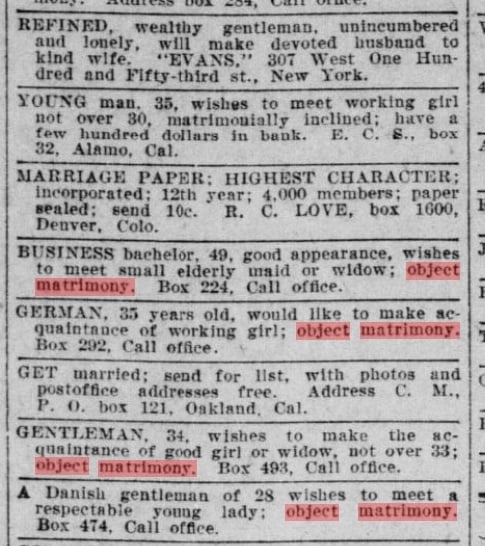
Publications like Matrimonial News (established 1870) and Heart and Hand circulated through the logging camps like currency. For a fee of a few cents, a man could post an advertisement detailing his prospects. The ads were rarely poetic. They were balance sheets. A man listed his acreage, his livestock, and the condition of his cabin. In return, he specified what he needed: usually "a woman of strong constitution," "accustomed to hard work," and "of good Christian character."
For women in eastern cities or immigrant enclaves, the Northwoods offered something the factories of Chicago or New York did not. It offered land and status. A widow with children, a woman considered a "spinster" at 25, or a recent immigrant working as a domestic servant saw these ads as a distinct career move. Marriage meant becoming the co-owner of a homestead rather than an employee in a sweatshop.
The "Tag" at the Train Station
The process was bureaucratic. Letters were exchanged, photographs were swapped (often outdated ones), and a proposal was made by post. If accepted, the man would send a train ticket.
This led to a common scene at depots in towns like Minocqua and Eagle River. A man would stand on the platform, clutching a letter or a specific object, such as a red handkerchief or a specific hat, so the woman disembarking the train could identify him.
There were no long courtships. In many cases, the couple went straight from the train station to the justice of the peace or the local minister. The deal was sealed before the bags were unpacked.
The Reality of the Cabin
If the women thought they were escaping the drudgery of city life, they were often mistaken. The Northwoods in the 1890s was unforgiving. Many of these "brides" arrived to find that the "cozy cabin" described in the letters was a windowless shack with a dirt floor.
The isolation was crushing. A woman might go months without seeing another female. While the husband worked the timber or the fields, the wife was responsible for everything else. She was hauling water from the creek, chopping firewood, skinning game, preserving food for winter, and acting as the doctor for the family.
Yet, despite the hardship, the divorce rate for these marriages was surprisingly low. There was no safety net. If you left, you starved. They stayed because they had to. In that shared struggle, many formed unbreakable partnerships that built the foundational families of this region.
Voices from the Archive
In 1887, a logger named Samuel Turner, operating near Eagle River, placed an ad that typified the era. It wasn't about romance. It was about survival.
"I am 32 years old, a Methodist, and in need of a good wife to share my home and keep my affairs in order. I have 160 acres of good land, a cabin of pine logs, and a strong team of horses. I can offer a comfortable home, warm in winter, with plenty of venison and trout for the table. A woman of good nature and strong constitution would do well here. I do not drink, nor do I expect a wife who does. Any lady who writes should be willing to come by train before the first snowfall, as travel is near impossible after December."
Turner eventually married a woman from Chicago. They raised five children on that land.
The Legacy
We tend to look at history through the lens of great men, like lumber barons and railroad tycoons. But the Northwoods was settled by the people who answered these ads. They were the risk-takers who bet their lives on a letter and a train ticket.
If your family has been in the Northwoods for more than three generations, there is a good chance your family tree includes a woman who stepped off a train with a suitcase, looked for a man holding a red handkerchief, and got to work.
You just read issue #26 of Northwoods Ledger. You can also browse the full archives of this newsletter.