
While their 30,000 quills are their most famous feature, the real story is how they survive their own clumsy nature.
The Physics of a Falling Rodent
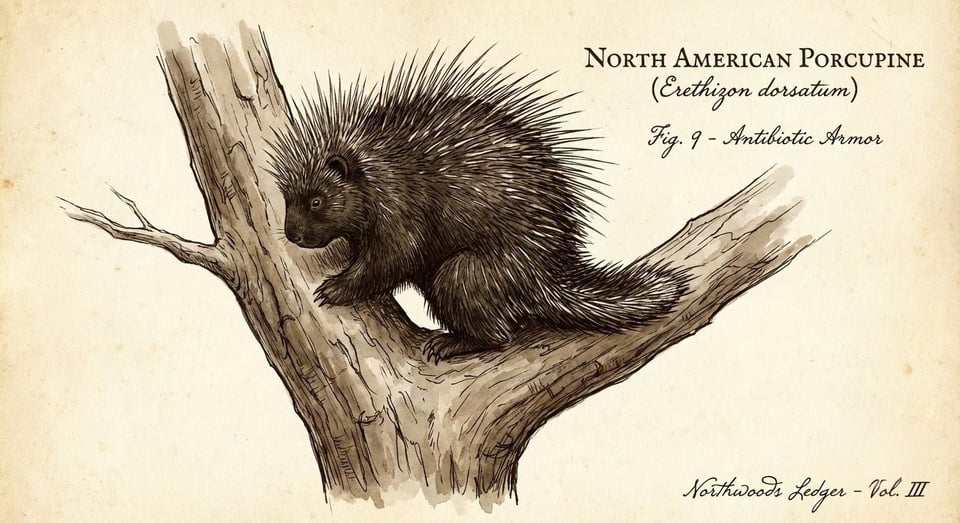
Porcupines are heavy. A mature adult can reach 20 pounds, and they often climb to the outer, thinner branches of the canopy to reach nutrient-dense buds. This leads to a recurring biological hazard. They fall out of trees with startling frequency.
Uldis Roze, a preeminent porcupine biologist, conducted a study on the skeletal remains of these animals to quantify this risk. His findings were conclusive.
Frequency of Injury: Roughly 35% of the skeletons examined showed evidence of healed fractures.
High-Impact Evidence: Roze found these are high impact injuries consistent with a heavy object hitting a frozen forest floor or a thick branch, rather than a predator’s bite.
Roze concluded that because porcupines are so focused on high-calorie buds at the very tips of branches, they constantly push the weight-bearing limits of the wood. For the porcupine, falling is not a rare accident. It is a predictable life event.
A Biological "Fail-Safe"
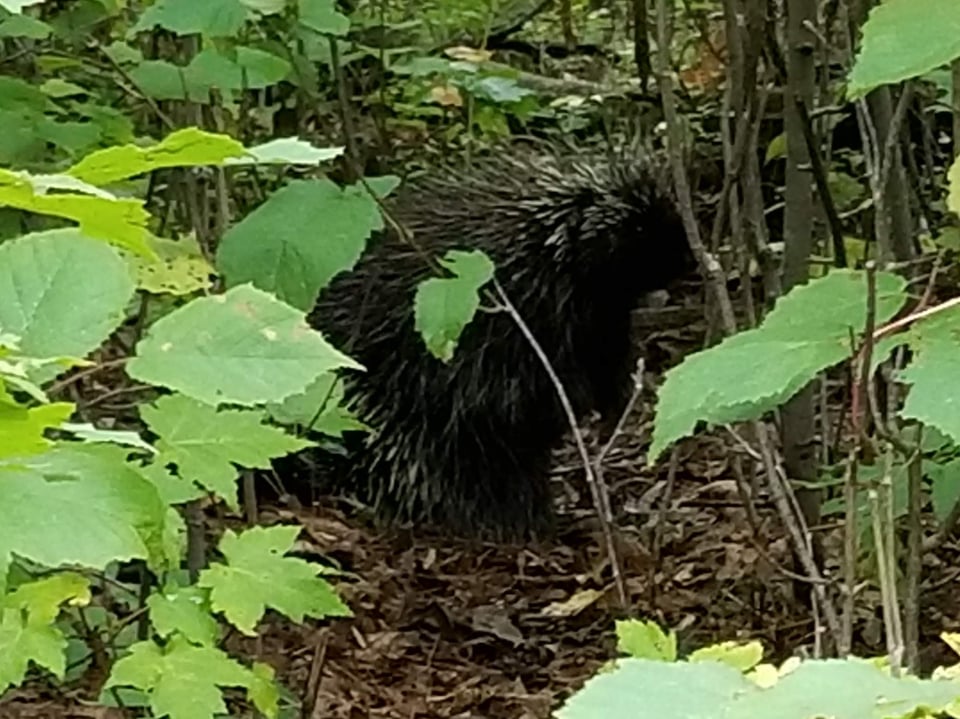
The quills are not just mechanical deterrents. They are pre-treated medical devices. Roze discovered quills embedded deep in muscle tissue and even scraping against bone in areas that a predator could not reach without killing the animal first. This suggested the animal was impaled by its own quills at the same moment the bone snapped.
To mitigate the risk of these self-inflicted wounds, the quills are coated in a layer of free fatty acids. These compounds function as potent, broad-spectrum antibiotics. They are particularly effective against Gram-positive bacteria like Staphylococcus, which are common in forest environments.
When a porcupine takes a tumble and stabs itself, the antibiotic coating is delivered directly into the wound. This built-in pharmacy allows the animal to recover from injuries that would be fatal to other Northwoods mammals. It is a rare example of a species evolving a chemical defense specifically to protect it from its own primary defensive tool.
The Engineering of the Barb
The quill itself is designed for deep penetration with minimal effort. Microscopic, backward-facing barbs cover the tip, functioning like shingles on a roof. These barbs reduce the force needed to pierce skin, but they make extraction nearly impossible.
Because of this structural design, quills tend to "travel" deeper into the body with every muscle contraction. If the porcupine stabs itself, the antibiotic coating is vital. That quill may migrate through several inches of tissue before it eventually works its way out.
Winter in the Canopy
Throughout the Wisconsin winter, you can spot these animals as dark, stationary balls tucked into the high crotches of hemlocks and oaks. They are a reminder that survival in the Northwoods is often about managing risk. The porcupine has its armor, but it also has the foresight to pack a medical kit for the inevitable fall.
You just read issue #63 of Northwoods Ledger. You can also browse the full archives of this newsletter.