We believe that informed voters are the only defense against fiscal mismanagement and the erosion of local resources. If you are a paid subscriber, thank you for making this work possible.
The Town of Lynne faces a $4.2 million repair bill for a road supporting 80,000-pound logging trucks. Minocqua faces similar costs along the same 30-mile corridor (Willow Road, Squirrel Lake Road, and Pine Lake Road). Both municipalities formally petitioned Oneida County to take jurisdiction over the route. They argue the road primarily serves county-level economic interests and handles heavy industrial traffic.
The county highway committee rejected the transfer to avoid the massive structural liability. They cited strict budget caps and an existing project backlog. This standoff exposes a core flaw in Wisconsin forestry statutes. The state revenue formula allows the county to retain the bulk of timber profits while leaving host towns to fund the resulting road repairs.
The Ledger Audit: The 1.4 Percent Failure
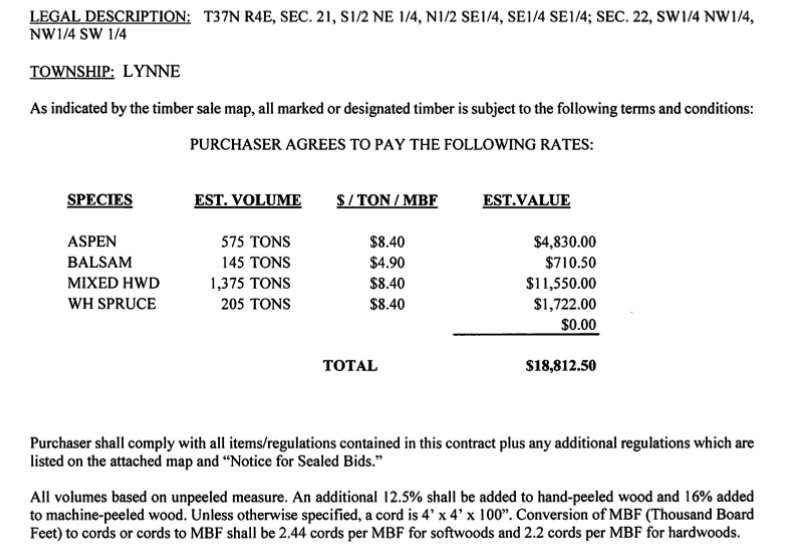
The Northwoods Ledger analyzed timber contracts for the Willow Road corridor. The system fails the towns mathematically.
Total County Timber Revenue (2021-2026) | $607,282.85 |
Total 10% Payment to Town of Lynne | $60,728.29 |
Estimated Road Repair Cost | $4,200,000.00 |
Percentage of Repair Covered by Logging Profit | 1.4% |
Oneida County extracted over $600,000 from the Lynne forest. The county deposits that money directly into its general fund to lower the overall tax levy. The town received roughly $60,000.
That payment covers exactly 1.4 percent of the repair bill. If Lynne saved every penny of its timber revenue strictly for road repairs, it would take 70 years to fund a single reconstruction project. Asphalt only has a lifespan of 20 to 25 years. The town is mathematically guaranteed to fall further into debt.
The Human Cost of Broken Asphalt
This dispute creates a physical hazard for daily commuters. The 30-mile corridor serves as a link between state highways for western Oneida County.
School buses navigate these failing roads twice a day. Emergency vehicles rely on this exact pavement to reach remote residential properties.
The broken road base also damages private property. Deep rutting physically yanks tires out of alignment and forces drivers into the center line. For local residents, the degraded asphalt acts as an unlegislated vehicle tax. Drivers regularly face mechanic bills for bent rims, cracked struts, and blown tires. Residents pay property taxes expecting safe passage. Instead, the state funding model leaves them paying for vehicle damage.
A 1963 Formula in a 2026 World
Wisconsin Statute 28.11 dictates how counties profit from public forests. The law enforces a rigid revenue formula. When Oneida County sells logging rights, it keeps 90 percent of the money. The host town receives 10 percent.
State lawmakers wrote this rule in 1963. At that time, logging trucks carried smaller payloads on different seasonal schedules. The cost of petroleum-based asphalt was also much lower.
Today, modern logging relies on multi-axle rigs carrying 40 tons of timber. The 1963 law ignores modern infrastructure realities and skyrocketing material costs. A rule designed 60 years ago as a helpful financial bonus now drains rural resources. A marginal timber harvest payment cannot repair a road bearing modern industrial traffic.
The Double Bind
Minocqua Chairman Mark Hartzheim calls the route a vital connection. The state labels it a regional highway but denies it highway funding. This "major collector" designation renders the road ineligible for standard local road grants, such as the Local Road Improvement Program, which are reserved for lower-volume routes. Towns face a regulatory trap. They must manage heavy highway traffic but cannot access the funds to fix the resulting damage.
This trap relies on how property taxes function. A resident pays separate county and town levies. When the county deposits timber profits into its general fund, it lowers the county tax rate for everyone. A property owner living 40 miles away receives the exact same tax break as a resident living directly on Willow Road.
However, the legal liability for the broken asphalt belongs exclusively to the town. Local residents must absorb millions in localized road debt to subsidize a minor county tax break for the entire region.
The revenue sharing further punishes Minocqua. Lynne receives a small payment for trees cut within its borders. Those heavy trucks then drive north through Minocqua to reach the state highway. Because the logging occurs south of the town line, Minocqua receives zero compensation for the wear and tear on its roads. Both towns absorb the exact same industrial traffic. Lynne officials state their maintenance needs now exceed all local resources. They face an impossible choice: enact massive property tax hikes or let the road revert to gravel.
Oneida County Highway Commissioner Ben Rich views the corridor as a massive liability. He cannot shift a $4 million debt from the towns to the county budget without canceling projects elsewhere. Accepting the transfer means abandoning maintenance plans for other townships. It merely shifts the crisis from one part of the county to another.
The Economic Counterpoint: A Struggling Industry
Lawmakers must navigate this fiscal gap carefully. The Northwoods timber industry struggles with rising diesel costs, severe labor shortages, and regional paper mill closures. As local mills shut down, loggers haul timber further distances. They burn more fuel and put more miles on local roads just to break even.
Increasing timber taxes or forcing independent loggers to pay for municipal road bonds could cripple the local economy. Logging provides thousands of jobs across Oneida, Vilas, and Price counties. These contractors operate on tight profit margins. Shifting a $4 million repair bill directly onto the industry would bankrupt smaller logging crews. If the loggers go out of business, the county loses its primary forestry revenue. Madison must solve the municipal funding crisis without killing the industry generating the wealth.
A Path Forward
Fixing this corridor requires a modern funding model acknowledging the true cost of rural logistics. State lawmakers have three actionable options to resolve the "10 Percent Trap" without destroying the timber industry:
Revenue Rebalancing: Madison could increase the municipal timber severance share from 10 percent to 30 percent specifically for towns managing designated "major collector" routes. This provides towns like Lynne and Minocqua with a sustainable maintenance fund without raising broad property taxes.
The Haul Route Grant Program: The state could establish a specific grant pool exclusively for local roads serving county and state forests. Instead of excluding "major collectors," the Department of Transportation would prioritize them based on documented logging tonnage.
The "Road Use" Credit: The state could allow counties to apply a portion of their 90 percent timber profit directly to town road repairs in the harvest area. This bypasses the rigid split and ensures the revenue follows the physical damage.
The Unsustainable Path
The Willow Road fight is not an isolated local dispute. It represents a broken state policy. Every Northwoods town bordering county forest land faces this exact structural deficit.
Trading jurisdiction offers only a temporary political fix. True relief requires the state legislature to open Statute 28.11 and rewrite the 10 percent rule. Madison must redirect a larger portion of existing timber profits back to the local infrastructure. Until state law accounts for the actual engineering costs of modern roads, local taxpayers will continue subsidizing county profits with broken asphalt.
You just read issue #87 of Northwoods Ledger. You can also browse the full archives of this newsletter.