
1. The Scene and the Hypocrisy
A regulatory double standard currently defines the Stacks Bay expansion project in Woodruff. If a private property owner clears shoreland without a permit, local authorities issue a stop-work order and levy daily fines. When the State of Wisconsin does it, state agencies claim sovereign immunity.
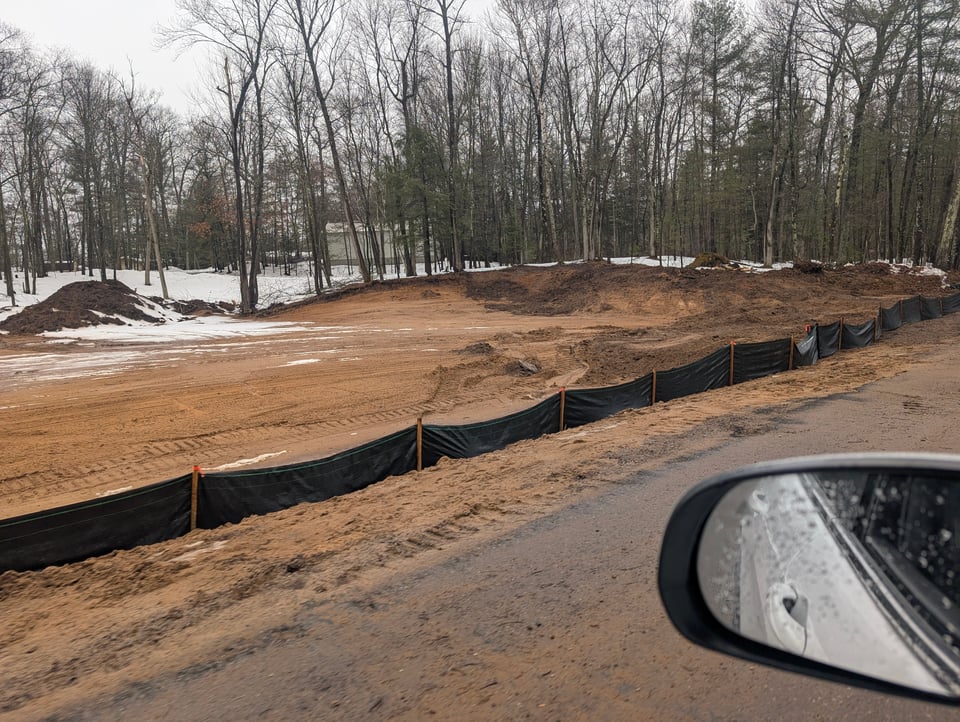
In this instance, the Department of Administration and the Department of Natural Resources bypassed local oversight entirely. On January 13, 2026, Oneida County zoning staff documented a site where state contractors had cleared approximately 100 trees and stripped the organic layer from 27,500 square feet of earth. This unauthorized excavation sits entirely open, with raw sediment left fully exposed to the elements less than 100 feet from the ordinary high water mark of Lake Minocqua.
2. The Blueprint Failure
The gap between engineering theory and site execution is where environmental liability occurs. The state contracted Robert E. Lee and Associates, Inc. to design the Stacks Bay expansion. Their blueprints, dated October 1, 2025, were technically sound and mandated specific protections for working in a shoreland zone. The plans explicitly required perimeter silt fencing to capture runoff, erosion control matting on all graded slopes, and a gravel tracking pad at the construction entrance.
By bypassing the county permit process, the state bypassed the inspector. Without an independent county auditor legally authorized to walk the site, the protective silt barriers mandated by the October blueprints were never installed.
3. The Enforcement Action
On February 23, 2026, the local zoning authority forced the issue. Oneida County Planning and Zoning Director Karl Jennrich issued a formal enforcement letter to the DOA and the DNR.
The County has drawn a hard line, demanding the state halt all non stabilization earthwork and submit to the same permit process required of any other developer.
4. The Legal Shield
The foundation of the state's defense rests on a 33 year old legal interpretation rather than legislature. The Department of Natural Resources uses a 1993 Attorney General opinion (81 Op. Att’y Gen. 56), authored by Jim Doyle, as a regulatory shield. In practice, the state uses this opinion to grant itself sovereign immunity from the exact county-level oversight designed to protect local watersheds.
Oneida County is countering this interpretation with an actual statute. Wisconsin Statute § 13.48(13) explicitly dictates that state building projects are "not subject to the ordinances or regulations of the municipality... except zoning". In the hierarchy of Wisconsin jurisprudence, a codified statute is binding law, while an Attorney General opinion is merely a persuasive interpretation. If this jurisdictional test reaches a courtroom, the state’s claim of sovereign immunity is structurally weak.
5. The Taxpayer Threat
The regulatory vacuum at Stacks Bay is an active economic liability. When raw sediment enters a navigable waterway, it carries high concentrations of phosphorus. This nutrient loading triggers algal blooms and accelerates the spread of aquatic invasive species like Eurasian watermilfoil.
If the water clarity in Stacks Bay degrades, the assessed value of the surrounding waterfront real estate declines. Because local school districts and municipal services rely heavily on high-value shoreland taxes, a drop in waterfront assessments shifts the tax burden directly onto off-water property owners. By operating under the assumption of sovereign immunity, the state has transferred the financial liability of their construction shortcuts directly onto the stakeholders of Oneida County.
6. The March 17 Escalation
The immediate friction point now sits with the Oneida County Board of Supervisors. They must decide how to handle the enforcement action if the state ignores the February 23 directive.
On March 17, 2026, the Board will vote on whether to authorize the Corporation Counsel to initiate litigation against the state Department of Justice. This looming vote will determine if local zoning laws carry actual operational weight, or if they are merely suggestions when the state acts as the developer.
You just read issue #66 of Northwoods Ledger. You can also browse the full archives of this newsletter.