
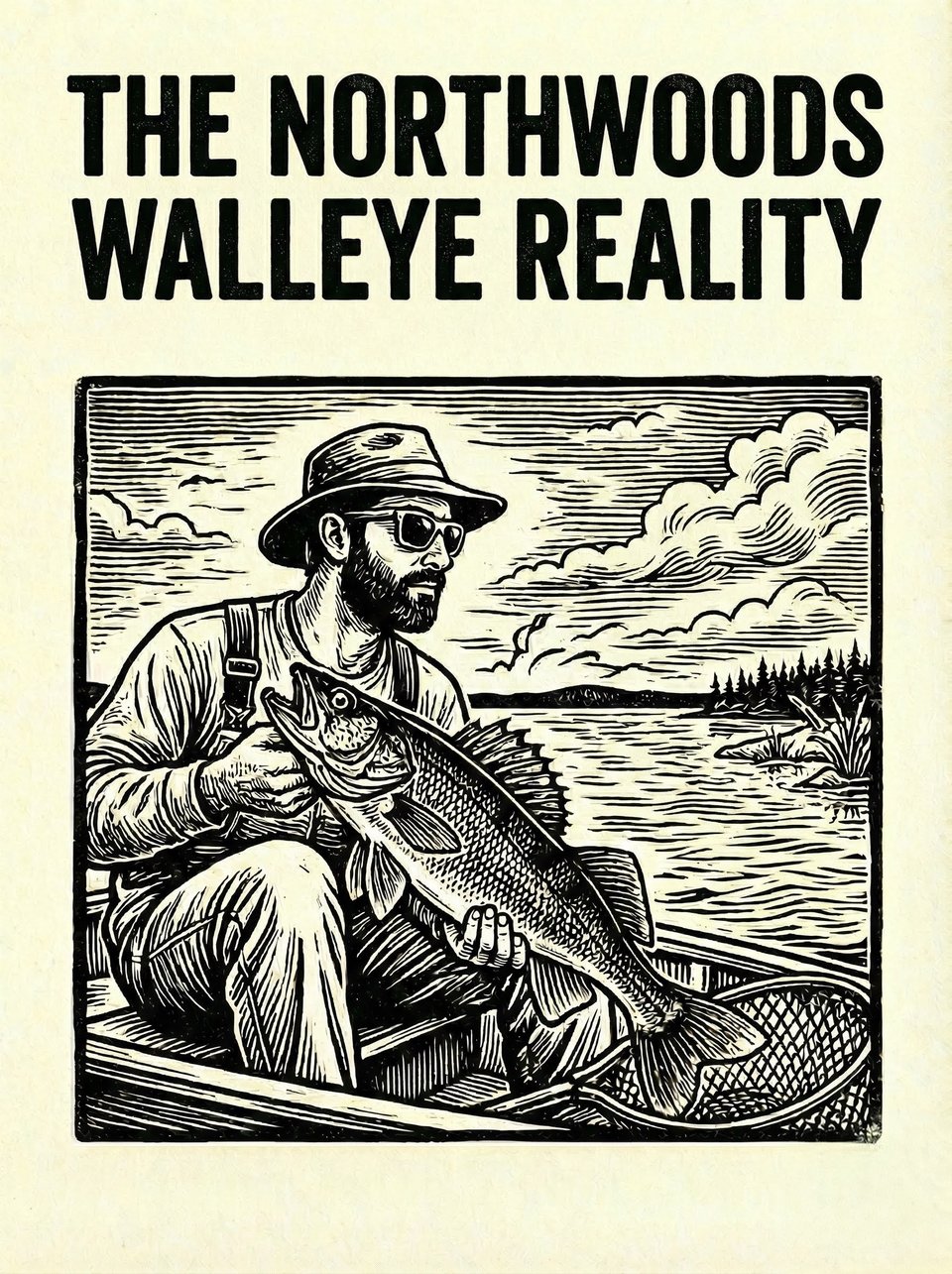
The 2026 Northwoods walleye fishery stands at a definitive crossroads. The walleye (Sander vitreus) faces unique pressures reshaping the Wisconsin Northwoods. This is not just a cycle. It is a fundamental shift driven by three pressures: a failure in baby fish survival, a leap in angling technology, and a lake ecosystem shifting in favor of warm-water fish.
This report is a forensic accounting of the current reality.
PART I: THE PRODUCTION CRISIS
To the casual observer in Minocqua or Eagle River, the lake looks unchanged. However, the engine of the fishery is sputtering. We are missing "eaters" today because the baby fish from three years ago never survived their first winter.
1. The Missing Freshman Class Fisheries management relies on "year classes." A healthy lake produces a crop of fry (baby fish) every spring. In a functional system, a predictable percentage survive to become adults four to five years later.
In 2025, many Northern Wisconsin lakes classified as "declining natural recruitment" (D-NR) lakes show the 2022 and 2023 year classes were statistically negligible. The adults spawned. The eggs hatched. But the fry disappeared before their first autumn. We are fishing in a gap.
2. The Timing Trap The primary driver is a breakdown in timing. Walleye spawning relies on ice-out and water temperature. Historically, this aligned perfectly with the "spring bloom" of zooplankton (microscopic animals that walleye fry must eat within days of hatching). In recent years, spring weather became erratic:
Scenario A (Late Ice): When ice stays late, water warms fast. The algae bloom happens too early. The food source booms and busts before walleye eggs hatch. When the fry emerge, the buffet is closed. They starve.
Scenario B (False Spring): Early thaws trigger spawning, followed by cold snaps. This kills eggs or stuns fry, making them easy prey for panfish.
Data from Escanaba Lake confirms these "boom or bust" cycles are now the norm.
PART II: THE ECOSYSTEM SHIFT (THE CLEAR WATER DESERT)
The Northwoods is changing due to invasive species and climate trends. We are seeing the rise of a "Clear Water Desert."
1. Losing the Darkness (Zebra Mussels) Walleye are built for low light. Their eyes have a reflective layer that gives them a predatory advantage in dim water. Invasive Zebra Mussels filter-feed on algae, stripping the water of the particles that provide cover.
Lakes like Minocqua and Lake Tomahawk are becoming clearer. In clear water, sunlight penetrates deeper. Walleye are forced deeper or into thick weeds during the day. Sight-feeders like Largemouth Bass and Bluegill thrive in this high-visibility environment and outcompete walleye.
2. The Food Chain Break (Spiny Water Flea) The Spiny Water Flea is an invasive plankton that eats the native zooplankton walleye fry need. Its long spine makes it inedible to small fish. It effectively starves young walleye while filling the water with "junk" calories.
3. The Bass vs. Walleye War Data shows a strong link between high Largemouth Bass density and low Walleye survival. The war is fought at the juvenile stage. Warmer, clearer lakes favor bass reproduction. An explosion of young bass competes directly with young walleye for food. In lakes with too many panfish and bass, walleye fry face a "gauntlet of mouths." When a walleye is 1 inch long, it is prey for a 4-inch bluegill.
4. Hardened Shorelines Walleye need clean gravel to spawn. They need gaps between rocks where eggs can settle. Developed shorelines with rip-rap and sea walls destroy this nursery. Wake boats also damage the bottom; research indicates high-energy waves scour lake bottoms at depths up to 20 feet, creating sediment clouds that suffocate walleye eggs.
PART III: THE TECHNOLOGICAL ARMS RACE
Forward-Facing Sonar (FFS) and side-imaging have altered the predator-prey dynamic, creating a disconnect between catch rates and actual health.
1. The Invisible Collapse The decline in fish numbers is invisible to recreational anglers on the water. As walleye populations shrink, they do not spread out evenly. Instead, they condense, bunching up tightly on specific structures.
Modern technology allows anglers to locate these remaining pockets with high efficiency. When an angler finds a school, catch rates remain very high. The fishery appears healthy right up until the moment the last few pockets are depleted. Then the population crashes overnight.
2. The End of "Suspended" Safety Historically, walleye suspended in the open water basin were safe. FFS allows anglers to see fish swimming in real-time up to 100 feet away. Anglers can now target specific, individual fish suspended in open water. These are often the largest breeding females.
3. The Cost of Catch-and-Release Public anxiety is high. In the 2024 Wisconsin Conservation Congress Spring Hearings, roughly 36% favored a ban on FFS. Beyond harvest, the biological risk is "the bends" (barotrauma). Fish brought up quickly from depths greater than 25 feet often suffer internal injury. Even if released, a fish with the bends often dies.
PART IV: HARVEST REALITY
Tribal harvest is highly regulated. Recreational regulations are tightening to account for survival failures.
1. 2024-2025 Tribal Harvest Tribes declare a quota (safe harvest ceiling) before the season. In 2024, actual harvest was roughly 61% of that number. If tribal harvest exceeds 60% of the limit on a lake for two consecutive years, quotas are automatically reduced.
Total Harvest: In the 2024 spring season, Wisconsin tribes harvested 38,825 walleyes in the Ceded Territory.
Oneida County: Tribal harvest was 7,439 walleyes.
Top Lakes: The Willow Flowage (1,853 fish) and Pelican Lake (2,086 fish).
2. Recreational Regulations
Minocqua Chain: Reopened for the 2024/25 season with strict limits: 1 fish daily bag, 18-inch minimum, and a no-harvest slot of 22-28 inches.
Crescent Lake: Due to poor survival, the DNR proposed a regulation change in March 2025 to a 15-inch minimum, with a 20-24 inch protected slot.
PART V: DISEASE WATCH
Heterosporis (Muscle Rot) This parasite liquefies muscle tissue in walleye and perch. It creates white patches that look like freezer burn and renders fillets unappetizing. It has been detected in Catfish Lake and the Eagle River Chain.
PART VI: RECOMMENDATIONS
1. Shift to "Extended Growth" Stocking We must stop stocking small fry in complex lakes. The timing mismatches detailed in Part I make fry stocking a gamble. Instead, resources should shift to "Extended Growth" walleye. These fish are raised in ponds until fall, reaching 6-8 inches. They bypass the vulnerable plankton-eating stage entirely, entering the lake too big for panfish to eat and with enough fat reserves to survive winter.
2. Wood is Good ("Fish Sticks") Landowners should use Wisconsin DNR "Healthy Lakes & Rivers" grants to install "Fish Sticks". Whole trees dropped into the near-shore water and anchored to the bank. A clean shoreline is a barren shoreline. Young perch and walleye require this "messy" carbon-rich cover to hide from predators and survive the first year.
3. The "Deep Water" Wake Rule Wake boats and heavy cruisers must operate in the main basin only. Operators should keep plowing speeds (bow high) out of water shallower than 20 feet. If you can see the bottom, high-energy prop wash is hitting it, scouring away the spawning gravel and suffocating eggs with silt.
4. Strategic Harvest (The 14-18 Inch Rule) We need a cultural shift regarding what constitutes a "trophy." The limit is a legal maximum, not a target. Anglers should harvest the abundant 14-to-18-inch male walleyes for eating. All fish over 22 inches must be released. These large females are the biological engines of the fishery, producing exponentially more eggs and carrying the genetics to survive changing conditions.
5. The Biology Blockade Anglers must dry their hulls to stop the spread of Spiny Water Flea and Zebra Mussels. Spiny water fleas are microscopic when attached to fishing line or carpet. If you jump lakes in a single day, you are the vector. Let the boat dry completely for 5 days, or pressure wash with hot water before switching bodies of water.
You just read issue #36 of Northwoods Ledger. You can also browse the full archives of this newsletter.