
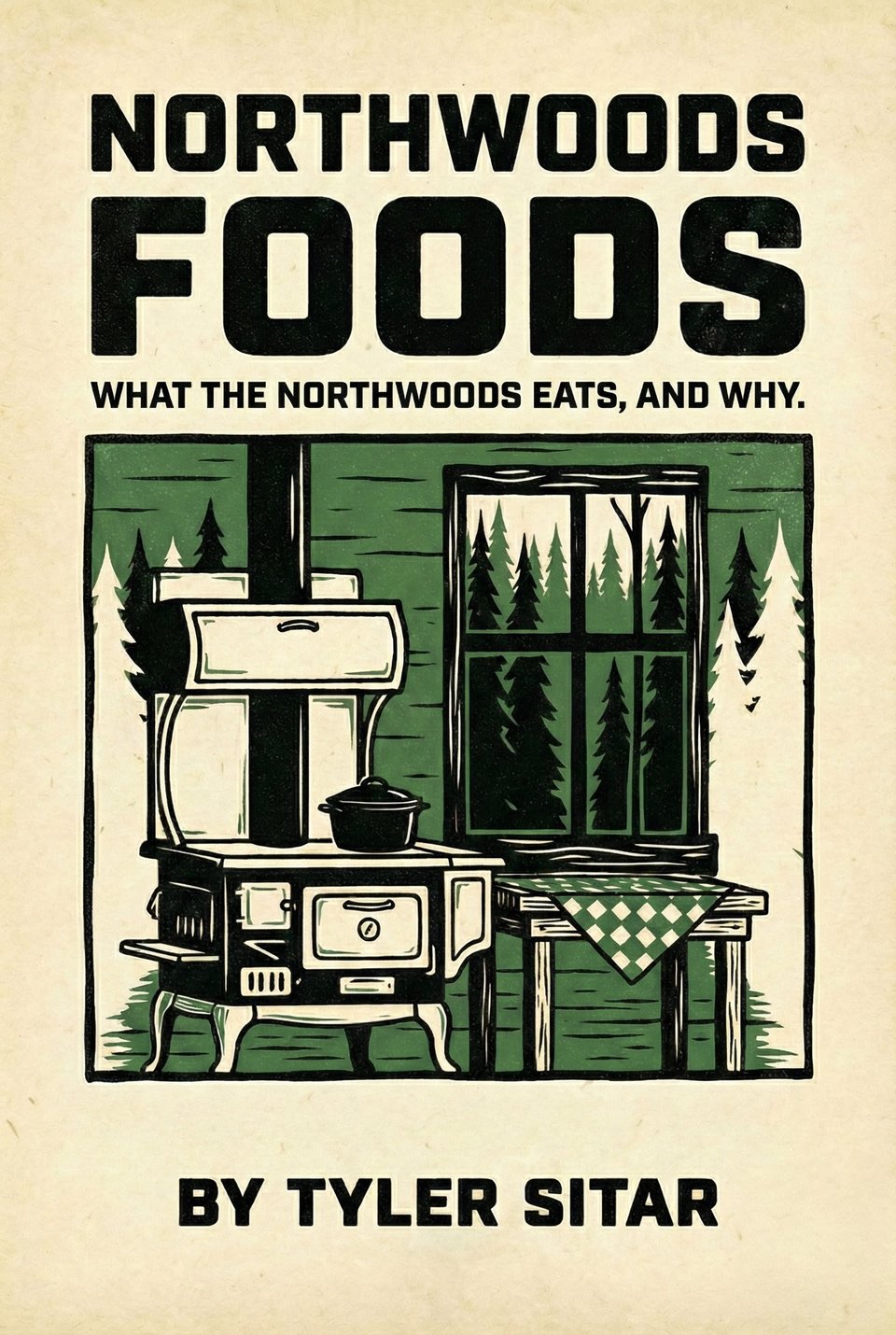
Northwoods foods

In the Northwoods, the seasons dictate the menu. We do not eat out of preference; we eat out of necessity.
When the ground freezes four feet deep and the growing season ends abruptly in September, you cook differently than you do in the south. Loggers, miners, and farmers working in sub-zero temperatures required meals that provided sustained warmth and endurance.
Our regional cuisine was engineered by people who had to outlast a six-month winter. That is why our food leans toward the rich and the hearty. It represents the art of preservation—smoking, curing, pickling, and casing. We eat the way we do because, for a century, the only way to see March was to preserve the harvest in October.
This book is a map of that adaptation. Every dish here tells a story of a specific immigrant wave that brought a technique, or a quirk of our soil that we learned to cultivate. This is how the Northwoods eats, and why.
Part I: The Indigenous Foundation
1. Wild Rice (Manoomin)
The Grain That Grows on Water
If you have only ever eaten the black, splintery "wild rice" from a grocery store box—which is often paddy-grown in California—you haven't eaten Manoomin. Real, hand-harvested wild rice from the lakes of Northern Wisconsin is a revelation. It is lighter, nuttier, and cures to a pale tan or variegated green color. When cooked, it smells like the river—grassy, toasted, and earthy.
For the Ojibwe, Manoomin is the fulfillment of a prophecy that led them to the Great Lakes to find "the food that grows on water." The harvest defies modern industrial efficiency. It requires a two-person team: one to pole the canoe through the dense reed beds without damaging the roots, and one to gently "knock" the ripe grains into the boat with cedar sticks (bawa'iganaakoog).
Once harvested, the work isn't done. The rice must be parched over a fire to dry it and loosen the hulls, then "danced" on (traditionally in leather moccasins) or thrashed to separate the grain from the chaff. Finally, it is winnowed in the wind using birch bark trays. The result is a grain that cooks in 20 minutes and possesses a smoky, tea-like flavor profile that cannot be replicated by machines.
Chef’s Note: Real Manoomin is fragile. It cooks fast—15 to 20 minutes max. If you boil it for 45 minutes like the black paddy rice, you’ll turn it to mush. Treat it like fresh pasta, not dried brown rice. The goal is for the grain to curl open, not explode.
2. Venison & Maple
The Protein and The Sugar
Before the arrival of pork and beef cattle, the Northwoods diet relied heavily on the Whitetail Deer. But venison presents a culinary challenge: it is incredibly lean. In the dead of winter, a diet of only lean meat can lead to "rabbit starvation"—a form of malnutrition where the body consumes its own protein for energy because it lacks fat. To survive, the Indigenous people and early settlers had to introduce energy sources.
That energy came from the sugar maples. The spring sap run wasn't just for making syrup to pour on pancakes; it was a vital preservation technique. Maple sugar was granulated and packed into birch bark cakes (makuks) to season meat and preserve berries throughout the year. The combination of smoked venison and maple is the foundational flavor profile of the region: smoke and sweet, protein and energy. It is the flavor of February survival.
Chef’s Note: When cooking venison, you are fighting the lack of intramuscular fat (marbling). Do not cook a loin past medium-rare (130°F), or it becomes distinctively metallic and livery. If you must braise a shoulder or roast, you have to introduce a foreign fat source—bacon fat or heavy butter—to carry the flavor and provide mouthfeel.
Part II: The Immigrant Pot (Function Over Form)
3. The Pasty (The Cornish Lunchbox)
Engineering the Perfect Meal
The Pasty is a triumph of industrial design. Brought to the mineral ranges of Southwestern Wisconsin by Cornish miners in the 1830s and 40s (before many moved north to the Iron Range), it solved a specific engineering problem: How do you feed a man who is hundreds of feet underground, covered in lead or arsenic-laced dust, with no way to wash his hands?
The answer was a handheld pie with a crust so thick and sturdy it acted as a disposable handle. The miner could hold the crimped rope edge, eat the steaming meat-and-potato filling, and toss the dirty crust away to the "knockers" (the mischievous ghosts of the mines).
A true pasty is dense, heavy, and virtually indestructible. It stays warm in a coat pocket for hours against a cold chest. The filling is simple: beef, potatoes, onions, and—if you are a purist—rutabaga (swedes). The rutabaga adds a specific earthiness and moisture that keeps the filling from drying out inside the pastry shell.
Chef’s Note: Texture is everything. A proper pasty uses cubed steak (skirt or flank), never ground beef. Ground beef turns into a meatloaf inside the crust. You want distinct chunks of meat and vegetable. And regarding the condiment war: Ketchup is the miner's choice; gravy is for tourists. The acid in ketchup cuts the fat of the crust.
The Master Recipe: The Miner's Crust
The secret to a crust that can survive a lunch pail without turning into a rock is the ratio of lard to butter.
3 cups All-Purpose Flour
1/2 cup Lard (Cold) - Provides the flakiness.
1/2 cup Unsalted Butter (Cold) - Provides the flavor.
1 tsp Salt
2/3 cup Ice Water
Method: Cut the fat into the flour until it resembles coarse gravel. Add ice water one tablespoon at a time until the dough just holds together. Do not overwork it. Chill for 1 hour before rolling. This crust is sturdy enough to hold a pound of filling but tender enough to eat without a knife.
4. Bratwurst & Beer (The German Infrastructure)
Preservation by Spices and Hops
German immigrants flooded Wisconsin in the mid-19th century because the soil and climate reminded them of home. They brought with them the two technologies that define our state's diet: brewing and sausage-making. Both are methods of extending a harvest.
A bratwurst is not just a hot dog. It is a preservation vessel. In a time before refrigeration, you couldn't keep a slaughtered pig fresh. You had to grind the scraps, spice them heavily with nutmeg, ginger, and caraway to ward off spoil, and case them in intestines. The bratwurst allowed a family to store high-quality protein in the root cellar or smokehouse.
Paired with beer—often called "liquid bread"—you had the caloric density required to clear forests. Beer was safer to drink than water in many early settlements because the brewing process involved boiling. The synergy of the bratwurst (fat/protein) and the beer (carbs/yeast) built the infrastructure of the North.
Chef’s Note: The "Beer Bath" is not just for flavor; it is temperature control. Never put a raw brat directly on a high-heat grill; the casing will snap, the fat will flare up, and you'll lose all the juice. Poach it gently in beer and onions first to cook the interior, then move it to the grill just to brown the skin. If the casing splits, you’ve failed the sausage.
The Master Recipe: The Proper Beer Poach
This is the only way to ensure a juicy interior and a crisp snap.
6 Raw Bratwursts (Fresh, not precooked)
2 Cans Cheap Lager (Don't waste the craft stuff here)
1 Large White Onion, sliced thick
1/2 Stick Butter
Method: Combine beer, onions, and butter in a pot. Bring to a simmer (never a rolling boil). Drop the brats in. Simmer gently for 15 minutes until they turn gray and firm up. Move immediately to a medium-high grill for 3-4 minutes per side to mark them. Serve topped with the beer-soaked onions.
5. Cheese (The Swiss Salvation)
From Wheat Failure to Dairy Empire
Wisconsin wasn't always the Dairy State. In the mid-1800s, we were the Wheat State. Milwaukee was once the largest wheat shipper in the world. But we farmed the land too hard, stripping the nitrogen from the soil until the crops failed. Then came the chinch bug infestations of the 1860s, which decimated what was left. The agricultural economy collapsed.
Salvation came from the Swiss immigrants in Green County and later throughout the state. They looked at the rolling, rocky hills that couldn't support a plow anymore and saw pasture. They brought the dairy cow. Cows eat grass (which grows easily here) and turn it into milk.
But milk is volatile; it spoils in days. To export that economic value to the cities, you have to stabilize it. You turn it into cheese. The cheese industry wasn't a culinary choice; it was an economic rescue plan that saved Wisconsin’s soil. The massive wheels of Swiss and rounds of Cheddar were effectively "banked" grass, stable enough to ship to Chicago and New York.
Chef’s Note: When cooking with aged Swiss or sharp Cheddar, grate it yourself. Pre-grated cheese is coated in cellulose (wood pulp) to keep it from clumping in the bag. That cellulose prevents the cheese from melting into a smooth sauce, resulting in a grainy fondue or mac and cheese.
6. The Cheese Curd (The Freshness Test)
The Sound of Integrity
To an outsider, a cheese curd is just a nugget of unaged cheddar. To us, it’s a clock.
That famous "squeak" isn't a gimmick; it’s the sound of structural integrity. It happens because the long, tightly wound protein strands inside the curd are still elastic and encased in calcium phosphate, rubbing against the enamel of your teeth like a new sneaker on a gym floor.
But that sound has a strict deadline. Within 24 hours of being separated from the whey, the lactic acid in the cheese breaks down those calcium bonds. The proteins relax. The squeak dies. A curd that doesn’t squeak isn't "bad" cheese—it’s just mild cheddar. But in the Northwoods, if it doesn't fight back when you bite it, it isn't fresh.
Chef’s Note: Do not refrigerate a fresh curd if you plan to eat it that day. Cold kills the squeak instantly by hardening the fats. Leave them on the counter. If you have "dead" curds from the fridge, you can sometimes revive a ghost of the squeak by microwaving them for 7 seconds—just enough to warm the proteins.
Part III: The Modern Classics (Tavern Culture)
7. The Friday Night Fish Fry
Communion in the Tavern
In the Northwoods, Friday night is a religion, and the Fish Fry is communion. The roots are Catholic—abstaining from meat on Fridays—but the institution was built by Prohibition (1920-1933).
When taverns lost the ability to sell alcohol legally, they needed a way to keep customers coming in the door. They turned to the cheapest resource available: the abundant Lake Perch, Bluegill, and Walleye in our waters. They offered "All You Can Eat" fish for pennies to cover the illicit beer sales in the back room. The repeal of Prohibition didn't stop the tradition; it cemented it.
Today, the sensory details are non-negotiable. It is a plate of brown and gold: the battered fish (beer batter or rye crumb), the slice of marbled rye bread, the creamy coleslaw to cut the grease, and the tartar sauce. It is the communal meal of the week, where bankers sit next to mechanics.
Chef’s Note: The secret to a Fish Fry isn't the fish; it's the recovery time of the oil. A bad fish fry is greasy because the kitchen overloaded the fryer, dropping the oil temp below 350 degrees. At low temps, the batter acts like a sponge. At high temps, the batter seals instantly, steaming the fish inside. A good fish fry is crisp and dry.
The Master Recipe: The Tavern Beer Batter
This batter is thin, crisp, and shatters when you bite it. It should coat the back of a spoon, but barely.
1 cup All-Purpose Flour
1/2 cup Cornstarch (Crucial for the crunch)
1 tsp Baking Powder
1 tsp Paprika
1 tsp Salt
1 cup Ice Cold Lager
Method: Whisk the dry ingredients. Whisk in the cold beer right before frying. The batter should be thin like crepe batter, not thick like pancakes. Dip the dry fish (dusted in flour first) into the wet batter and drop immediately into 375°F oil.
8. The Brandy Old Fashioned
The Wisconsin Exception
Order an Old Fashioned in New York, and you get whiskey, a sugar cube, and a lemon peel. Order one in the Northwoods, and you get Korbel Brandy, a muddling of cherries and oranges, and a splash of soda (Sweet for Sprite, Sour for Squirt).
Why Brandy? In 1893, the Korbel brothers brought their California brandy to the World's Columbian Exposition in Chicago. The massive German population of Wisconsin—already culturally fond of fruit distills and brandy—fell in love with it. We drank so much of it that Wisconsin eventually cornered the market on domestic brandy.
We drink it "muddled" and topped with soda to mask the bite of the liquor, creating a cocktail that tastes more like fruit punch than a stiff drink. It is the distinct flavor of a Wisconsin supper club, best consumed with bitters and bar snacks.
Chef’s Note: Muddle the fruit. If the bartender just drops a cherry in the glass without smashing it into the bitters and sugar, question your choices. You need the oils from the orange rind and the juice from the cherry to emulsify with the sugar before the ice hits the glass.
The Master Recipe: Northwoods Brandy Old Fashioned (Sweet)
1 Sugar Cube (or 1 tsp sugar)
3 Dashes Angostura Bitters
1 Orange Slice
1 Maraschino Cherry (plus one for garnish)
2 oz Brandy (Korbel is standard)
Lemon-Lime Soda (Sprite/7Up)
Method: Place sugar, bitters, orange slice, and one cherry in a heavy bottom glass. Muddle aggressively until the sugar is dissolved and the fruit is smashed. Add ice to the top of the glass. Pour in the brandy. Top with soda. Stir. Garnish with a fresh cherry and orange slice on a pick.
9. Booyah
The Community Kettle
Booyah is technically a soup—a thick, slow-cooked stew of chicken, vegetables, and beef bones—but really, it is an event. You don't make a "small batch" of Booyah. You make it in a 50-gallon cast-iron kettle over a wood fire, stirred with a canoe paddle.
Originating with Walloon (Belgian) immigrants in the Green Bay area, Booyah (likely from bouillon) was the solution to community feeding. Everyone brought what they had—an old laying hen, a bag of carrots, a sack of potatoes, ox tails—and it all went into the communal pot. It represents the "barn raising" spirit of the North: we are better when we pool our resources. The resulting stew is thick, gelatinous, and rich—the taste of community cooperation.
Chef’s Note: Booyah takes two days. One day to make the broth from bones, and one day to cook the vegetables. If you rush it, it’s just chicken soup. The "stickiness" of real Booyah comes from the breakdown of collagen in the bones over 12+ hours.
The Master Recipe: Backyard Booyah (scaled down)
2 lbs Oxtail or Beef Shank (Bone-in is mandatory)
1 Whole Chicken (Old stewing hens are best)
2 lbs Carrots, large dice
2 lbs Potatoes, large dice
2 lbs Onions, chopped
1 Head Cabbage, chopped
1 can Peas (Added at the very end)
Lemon Juice to finish
Method: Day 1: Simmer beef and chicken in water for 8 hours. Remove meat, shred, and discard bones. Chill stock (it should turn to jelly). Day 2: Bring stock to boil. Add beef, chicken, onions, carrots, and potatoes. Simmer 4 hours until vegetables "melt" into the broth. Add cabbage in the last hour. Add peas and lemon juice right before serving.
Conclusion: The Table is Set
These dishes aren't delicate. They are built for work, for winter, and for gathering. When you eat a pasty or drink an Old Fashioned, you are participating in a ritual of survival that has kept the Northwoods running for 150 years.
We eat this way because we have to. And because it tastes like home.
About the Author
Tyler Sitar is a chef and the editor of the Northwoods Ledger. He writes about the intersection of food, history, and community in the Upper Midwest.
Want more Northwoods stories? This guide is just a taste of the deep dives we publish every week. Join the Northwoods Ledger community to get investigative reports, local fiction, and seasonal updates delivered directly to your inbox.